https://boisedev.com/2025/03/20/wilks-brothers-skirting-subdivision-rules-in-plan-to-sell-2000-acres-near-cascade-2/

BOISEDEV ICYMI 2025
In Case You Missed It: Some of our best stories of the year

A company owned by Texas billionaires Dan and Faris Wilks is selling 73 ranch sites carved from about 2,000 acres south of Cascade.

Plans for Legacy Creek Ranch, as dubbed by DF Development, look like subdivisions across Valley County, but are not subject to the same rules and review process because the ranch sites were created by a series of lot line adjustments and original parcel splits.

That, Valley County Planning and Zoning Administrator Cynda Herrick said, is the difference between selling raw land and being required to follow the county’s subdivision laws.

“I’ve been talking with (DF) and they understand that this isn’t the preferred method,” Herrick told Valley Lookout. “But it’s what they’re entitled to by law.”

The method used by DF enables Legacy Creek Ranch to avoid the county’s subdivision requirements, which include plans for drainage, irrigation, drinking water, septic systems, utilities, and streets.

It also means that the company is not required to create a fire protection plan covering things like water supply, emergency access, and vegetation management.
The plan also avoids review by the Valley County Planning and Zoning Commission, as well as several state agencies, including the Idaho Transportation Department, the Idaho Department of Environmental Quality, and the Idaho Department of Water Resources.   READ MORE

Volunteers clear nearly 500 fallen trees from Forest Service roads | Coeur d’Alene Press https://share.google/6dS7zogwVPNW5DTuF

Volunteers assess road conditions in the Fernan Hill area following last week’s high winds. Volunteers removed nearly 500 fallen trees from area Forest Service Roads over the weekend.

by HAILEY HILL
Staff Writer | December 26, 2025 1:08 AM

It’s not just snowmobilers that recreate on North Idaho’s National Forest land, said Back Country ATV and UTV Association President Bret Uhlich.

Hikers, cross-country skiers and even sled dog teams take advantage of the groomed backroads and trails that make winter recreation accessible.

“We all love the backcountry,” Uhlich said.

It was this love for the backcountry that united 75 volunteers Saturday, enough manpower to clear nearly 500 fallen trees along Bunco Road, Fernan and the Fourth of July Pass.

Most volunteers were members of local organizations, including the Back Country ATV and UTV Association, the Coeur d’Alene Snowmobile Club and multiple Jeep clubs.

“Calls for action” were issued last week after high winds tore through North Idaho, downing trees, damaging infrastructure and resulting in one death.

One member of the Snowmobile Club had driven up into the Fernan Saddle area Wednesday to assess the road conditions and found trees nearly 2 feet in diameter toppled across the dirt road.

The club member was able to clear a quarter mile of the roadway by himself.

“Progress is possible, but it is slow, hard work,” the Snowmobile Club shared to social media Dec. 18.

With volunteers split into nine teams, several dozen miles of roadway were cleared of downed trees and other debris.

Cutting and moving the downed trees out of the roadways will save groomers both time and resources once the area receives significant snowfall, said Coeur d’Alene Snowmobile Club President Steven Cox.

The work will also allow outdoor enthusiasts to access the trails earlier in the season.

“I figured we should use the brief window we have before it started to snow,” Cox said.

These efforts underscored the importance of organizations like the Snowmobile Club, he added.

“This shows exactly what the need for this club is,” Cox said. “It was really good to see how many people came together to do this.”

And though there’s still plenty more work left to do, time and weather will determine whether crews can safely get back out there.

“There’s more to go, but unfortunately it’s a little dicey out there,” Uhlich said.

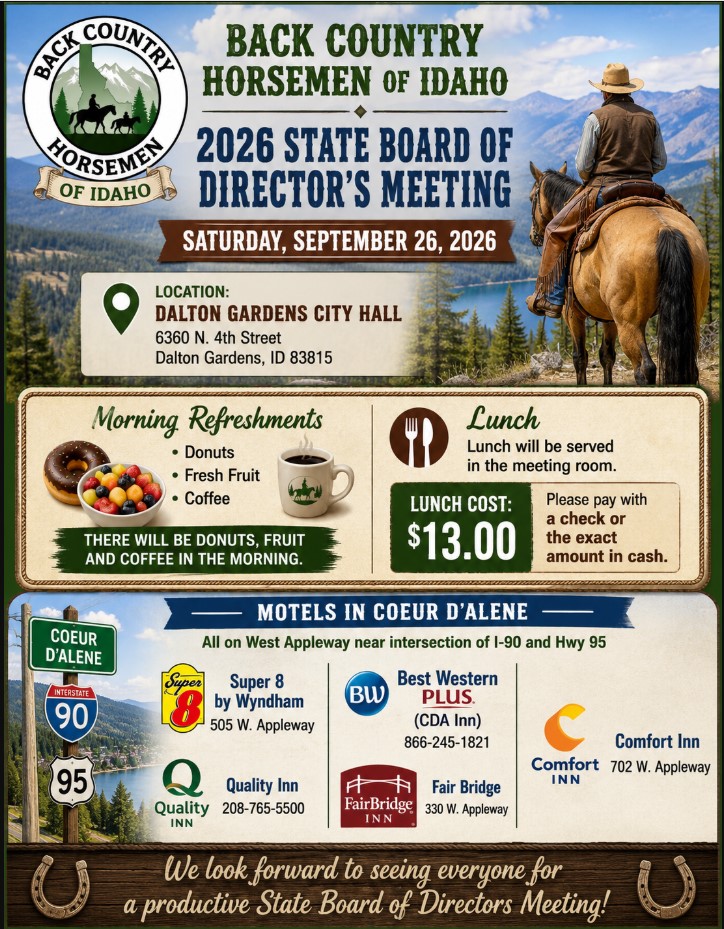
2026_bch_convention_flyer_8_6_25_second_adjustment

Interactive maps

Trails in East Idaho

Teton and Palisades Ranger District

Caribou National Forest, Westside Ranger District

Watch Videos

The EXPLORE Act (Expanding Public Lands Outdoor Recreation Experiences Act), signed into law in January 2025, is a bipartisan U.S. law designed to boost outdoor recreation on public lands by modernizing permits, improving infrastructure, supporting rural economies, and increasing access for all Americans, including veterans and underserved communities, through provisions like streamlined processes, new trails, and better camping facilities, while also protecting natural resources. 
Key Goals & Provisions:
  • Streamlined Permitting: Makes it easier for outfitters, guides, and nonprofits to operate on public lands.
  • Improved Access: Creates new bike trails, modernizes campgrounds, and helps underserved communities get parks and green spaces.
  • Economic Support: Benefits local economies, especially in rural areas, by supporting recreation businesses and infrastructure.
  • Modernization: Updates technology and processes for visitor experiences, like online passes and better data.
  • Inclusivity: Includes provisions for adaptive trails for veterans and people with disabilities (like the Military & Veterans in Parks Act).
  • Expanded Opportunities: Supports activities like shooting ranges, climbing, and camping. 
Why it’s Important:
  • Comprehensive: A package of multiple recreation-focused bills rolled into one.
  • Bipartisan: Passed with broad support in Congress.
  • Sustainable: Aims to grow the outdoor economy without harming natural resources, preventing degradation at busy sites. 
In essence, the EXPLORE Act makes it simpler and more accessible for more people to enjoy America’s public lands and waters. 

GO TO WEB SITE

2025 Session Recordings

Click here to view the recorded sessions from  2021-2025, including a brief description, list of presenters, and available recordings.


Much of Wyoming outside of Yellowstone and Grand Teton also struggles with emergency response time.
By Katie KlingspornWyoFile

Wyoming’s U.S. Sen. John Barrasso is pushing legislation to upgrade emergency communications in national parks — a step he says would improve responses in far-flung areas of parks like Yellowstone and Grand Teton national parks.

“This bill improves the speed and accuracy of emergency responders in locating and assisting callers in need of emergency assistance,” Barrasso told members of the National Parks Subcommittee last week during a hearing on the bill. “These moments make a difference between visitors being able to receive quick care and continue their trip or facing more serious medical complications.”

The legislation directs the U.S. Department of the Interior to develop a plan to upgrade National Park Service 911 call centers with next-generation 911 technology.

Among other things, these upgrades would enable them to receive text messages, images and videos in addition to phone calls, enhancing their ability to respond to emergencies or rescues in the parks.

A rescue litter is delivered to Jenny Lake Climbing Rangers. A new report compiled by ranger George Montopoli and his daughter Michelle Montopoli show trends in search and rescue incidents in Grand Teton National Park. Photo: Courtesy of Grand Teton National Park

Each year, rangers and emergency services respond to a wide range of calls — from lost hikers to car accidents and grizzly maulings — in the Wyoming parks’ combined 2.5 million acres.

Outside park boundaries, the state’s emergency service providers also face steep challenges, namely achieving financial viability. Many patients, meantime, encounter a lack of uniformity and longer 911 response times in the state’s so-called frontier areas. 

Improving the availability of ground ambulance services to respond to 911 calls is a major priority in Wyoming’s recent application for federal Rural Health Transformation Project funds.

READ MORE

Bipartisan legislators in the House this week co-authored a bill to outlaw the intentional use of snowmobiles and other motorized vehicles to ram and crush coyotes, wolves, and other animals on federal land.

The Snowmobiles Aren’t Weapons (SAW) Act would “close a glaring gap in federal wildlife protections,” according to the conservation group, Animal Wellness Action.

While several states prohibit hunting wildlife “from motor vehicles,” most states, not including Minnesota, Oregon, and Colorado, do not explicitly outlaw ramming or running over animals with a motorized vehicle on federal land.

“At a time when the House is taking up problematic legislation to remove federal protections for gray wolves from the Endangered Species Act, it’s more important than ever to stand up for responsible stewardship of our public lands and wildlife,” said Rep. Val Hoyle, D-Ore. “This bipartisan legislation shows we can work through thoughtful policy debates on conservation and wildlife management without condoning cruel and dangerous practices that threaten animals and public safety.”

The bill was co-sponsored by Mike Lawler, R-N.Y., Debbie Dingell, D-Mich., and Brian Fitzpatrick, R-Pa.

saw_act_full_bill_text

Volunteer-Hours-Report-2025 SBBCH

Click Here

After receiving a lot of flak

Court said Forest Service plans too vague and failed to consider grizzly bear habitat

By Darrell Ehrlick DAILY MONTANAN

A federal judge halted a large logging project near Yellowstone National Park because he said the United States Forest Service submitted plans that made it impossible to judge how it would affect critical grizzly bear habitat.

The 16,500-acre project located in the Custer Gallatin National Forest would have allowed the U.S. Forest Service to select timber and build roads for logging, but without offering specifics, only pledging that its plans would consider the total distance of the roads and not exceed certain parameters in acreage size, designed to protect critical bear habitat.

However, Judge Donald W. Molloy said that the plans amounted to giving the Forest Service permission and trusting that it would be compliant later. He also said in a 46-page ruling released Thursday that the plans also made it difficult to judge how the logging project would impact grizzly habitat, and that U.S. Fish and Wildlife Service said a female grizzly’s minimum range was 10 acres, while not basing that decision on any cited science. READ FULL STORY

READ ALL ABOUT IT


How do I hang a pack saw on my saddle?
One sure way to secure a saw to your riding saddle is to tie the pack saw handle with the rear saddle strings and then secure the blade under your leg. However, the pack saw scabbard has a versatile design that would allow you many options. Whichever way you choose, remember to offset the added weight of your saw by loading your horse saddlebags or horn bags heavier on the opposing side.

Why do I need to carry a pack saw or a camp axe with me on the trail?

The obvious answer here is for windfall blocking the trail. It is not always possible to go around a windfall, nor would you necessarily want to get into that habit; the new trail you would create only adds to the erosion of a potentially fragile area. It is better instead to simply clear the trail.  Read the article “Pack Saws and Camp Axes” for a full explanation of why it is so important to carry a pack saw when you are out on the trail.

Hey Folks,
I’m reaching out to highlight our appreciation for your time and energy in working with the Boise National Forest and our north zone (Cascade, Emmett and Lowman District) trails program.
I’m currently applying for trail grant funding to pay for crews to do work on motorized and non-motorized trials in 2027 and 2028. The reason for this timeline is that I learn whether we are awarded the grant in early summer 2026 and can’t receive funding until the fall of 2026, therefore I use that funding to pay for crew time the following year.

I have attached a draft of our current trail grant; I also send a draft of the grant to the IDPR committee that oversees the awarding of RTP grants.

What I need from your organization if you haven’t already submitted it: Volunteer hours for the 2025 field season. I have attached a volunteer report form, but you can also use a different format, number of volunteers number of hours (8 is the minimum for a day) and where are really helpful. What I need if your group would like to support the Boise NF in it’s grant request for 2026. A letter of support.

I use volunteer hours to make up the %5 non-federal match. Currently IDPR lists that value at $7.25 an hour for the RTP grant. I have made a request to update that amount to match the actual value that volunteers contribute, so hopefully that will change at some point. The letter of support needs to list the number of volunteer hours a group is willing to support us doing trail work during the years we will have the grant. The letter must explicitly state the number of hours, as per IDPR policy. I generally use the previous year’s volunteer hours or take an average. I am happy to help sort out hours and draft a letter or provide examples if needed. If you don’t want to state you will help with hours, just a note that you support the grant is also helpful.

Second, please let me know if there is a time when I could attend a club meeting in January, February or March and what date, time and location the meeting would occur and I can give an update on 2025 trail work and future planning.

Again, thank you so much for the support and help, we covered a lot of ground in 2025 and addressed lots of post fire impacts with help from so many partners. We certainly couldn’t do the work without you.

READ FULL STORY:  Historically Bad Year for Public Lands

READ FULL STORY:  Horseback Ride Fall – 2025

READ FULL STORY:  Hiker Rescued From Quicksand

Outdoor communication keeps getting smarter, smaller, and, like all thing, more expensive. Garmin’s new inReach Mini 3 Plus ($499) adds a touchscreen, voice messaging, and photo sharing to a device that once prided itself on being almost stubbornly simple.

The new version jumps from a tiny grayscale screen and a handful of buttons to something closer to a stripped-down phone. It sends voice messages, supports photo viewing, allows photo sharing when paired with the Messenger app, and uses a touchscreen for faster navigation. It’s a sharp turn for a device best known for blunt practicality.

The core inReach pieces are still here. Two-way messaging, SOS support, and LiveTrack all remain, now delivered through a color screen with built-in audio tools. Battery life stretches up to 330 hours in 10-minute tracking mode, which should get most people through long trips without rationing power.  READ FULL STORY


READ FULL STORY

Wound Care PG

(PDF)

The Wilderness Medical Society convened an expert panel of clinicians and researchers to appraise and update the WMS clinical practice guidelines for out-of-hospital evaluation and treatment of accidental hypothermia. The panel readdressed previously posed questions and considered additional questions not previously considered. All articles were considered, but those published between 2013 and 2019 were the focus of the review. The 2019 guidelines are the product of this effort. The guidelines focus on pre-hospital treatment, although hospital capabilities are discussed and considered for transport and triage recommendations.

Accidental hypothermia is the unintentional drop in core temperature to 35°C (95°F) or lower, and is a result of net heat loss from the body. For the purposes of out-of-hospital assessment, classification of hypothermia is based upon the clinical presentation of the patient. Core temperature is addressed, but this is frequently impossible to reliably, or safely, obtain in the field. The key considerations for classification and treatment are level of consciousness, alertness, intensity of shivering, physical capacity, and cardiovascular stability. The “Cold Card,” presented in the guidelines, provides a succinct summary and is easy to carry into the field.
The cold stressed patient [core temperature >35°C (95°F)], is not hypothermic. They have a normal mental status, coordination, are alert, and will be shivering to produce heat. The mildly hypothermic patient [core temperature 35-32°C (95-89.6°F)] will demonstrate impaired movement, often manifesting as poor coordination. They may be mildly tachycardic, but blood pressure will be normal. Moderate hypothermia [core temperature 32-28°C (89.6°-82.4°F)] is remarkable for worsening coordination, changing mental status, and decreased alertness. Shivering may still be present in patients with moderate hypothermia. Careful handling is imperative for these patients. Patients with severe/profound hypothermia [core temperature <28C° (82.4°F)] demonstrate a marked decrease in their level of consciousness, to the point of coma, will no longer be shivering, and demonstrate cardiac instability. These patients must be handled very carefully to prevent ventricular arrhythmias. If no pulse is present after a one-minute check, compressions should be started.

Treatment is progressive, depending on the state of hypothermia. Field rewarming begins with the prevention of further heat loss by protecting the patient from the environment – including the safe removal of wet clothing, and initiation of rewarming. Rescuers must be aware of the possibility of afterdrop and circumrescue collapse, both of which can be triggered by moving a patient from the horizontal position. After protection from the environment, methods of active field rewarming employ a combination of an insulative layer, a vapor barrier to prevent evaporative heat loss, and an external heat source. Examples of the heat source include chemical heat packs, forced air, and hot water bottles. Heat should be applied to the axilla and chest and care taken to monitor for burns. It is not recommended that small chemical heat packs (hand warmers) be used for core rewarming as they do not provide sufficient heat to affect core temperature. Immersion in warm water or a warm shower is not recommended for patients with hypothermia as it may lead to shock due to peripheral vasodilation.

Resuscitation of hypothermic patients differs from normothermic patients in that compressions are NOT started if there is any palpable pulse – regardless of rate. Rescuers should palpate for a pulse for at least one minute and only start compressions if no pulse is present. If a monitor is available, the rhythm should be assessed. A nonperfusing rhythm, such as ventricular fibrillation or asystole, is an indication to begin compressions. Organized electrical activity without a pulse (PEA) should be assessed with ETCO2 (end-tidal carbon dioxide) monitoring. If ETCO2 indicates there is perfusion, do no initiate compressions. Resuscitation is not initiated in patients with fixed, dilated pupils, obvious fatal injuries, and rigor mortis. Lividity is an unpredictable indicator in hypothermic patients so is not to be used as a sign of death.
Accidental hypothermia in the wilderness environment rarely occurs with readily available transport. In those needing active resuscitation, transporting is a challenge, however, and may be unsafe for rescuers. Compressions may be interrupted for up to 5 minutes while moving the patient. Compressions should resume for at least 5 minutes before the next interruption.
Once advanced field interventions are available, IV access should be attempted, and warm fluid resuscitation initiated. An AED or defibrillator may be employed for a shockable rhythm. If the body temperature is below 30°C (85°F), only one attempt should be made. Further attempts are indicated once the temperature is greater than 30°C. Medications for resuscitation should not be administered until the core temperature is above 30°C, and then intervals for administration should be doubled. If airway protection is indicated, it should be initiated when available. Ventilation rate should be guided by ETCO2, and if not available, care must be taken to not hyperventilate the patient.

Patients with moderate and severe hypothermia are to be transported to a hospital capable of caring for them. Patients with cold stress and mild symptoms need not be transported if they have been successfully treated in the field. Patients with hemodynamic instability, and especially those requiring compressions, should be transported to a facility capable of extracorporeal cardiac life support (ECLS), preferably extracorporeal membrane oxygenation although cardiopulmonary bypass is an option. Rescuers should use good judgement and not bypass a facility if transport times are lengthy. The transport vehicle should be heated to 28°C (82.4°F), however, may be quite uncomfortable for attendants and pilots.

The ultimate outcome for the hypothermic patient is dependent on prompt recognition and classification of symptoms, protection from further heat loss, initiation of active rewarming, gentle handling during rescue, and appropriate resuscitation. In cases of severe and hemodynamically unstable hypothermia, transport to an ECLS capable facility will further improve the patient’s chances for survival.

Introduction

Prior to 2001, tourniquets (TQ) were inferiorly made, lacked evidence and effective training, and their use was discouraged. However, with effective modern TQ science, development, and TQ inclusion into the Tactical Combat Casualty Care (TCCC) guidelines, TQs became universally accepted by 2006 in the military as the primary option for extremity arterial bleeding.  Eventually TQ use transitioned with success to civilian Emergency Medical Service/Fire Department personnel, Law Enforcement personnel, and first responders. Yet, there still is a need to overcome TQ myths (Table 1). Additionally, history reveals from WWII to present that mistakes will occur when applying a TQ (Table 2). For instance, many TQs have been applied to injured extremities without life-threatening bleeding in both military and civilian casualties. Many of these applied TQs were inappropriate since many were placed without visualizing the wound when not in a direct threat environment. In addition, when TQs are applied for over 2 hours, there will be progressive damage that may result in muscle necrosis, need for fasciotomy, renal failure, amputation, and death. This suggests a greater need for TQ education and training.
READ MORE

PDF: Tourniquet Lessons Learned from Ukraine and Israel

As an outcome from recent TQ lessons learned in the Ukraine and Israel wars, an article by Colonel John Holcomb, MD and colleagues was recently published in the Journal of Trauma, December 2023. They describe a renewed attention and education about how to avoid prolonged TQ application as recommended in the TCCC guidelines (See Massive Hemorrhage and Circulation sections – Table 3). It is our intent to provide the wilderness medical provider information about: 1) TQ replacement and TQ conversion (ideally performed no later than 2 hours after being applied); and 2) ensure the reader has up-to-date CoTCCC resources with the current TQ replacement/TQ conversion education and training.

LINK TO VIDEO

Preview of “Doing Good in the Great Outdoors”

Preview: Season 43 Episode 1 | 30s

We meet trail crews, naturalists, hunters, parks volunteers and even some budding high school biologists who give of their time and their talents to make the Idaho outdoors a better place, and model America’s spirit of volunteerism and citizenship in doing so.

12/04/2025 | Rating TV-G

28. November 2025 · Comments Off on On the trail with “PUG’s” Greg Travelstead · Categories: Around The Campfire, Trail Volunteer Groups

Greg Travelstead spends five to six days at a time working for free with trail crews in the Sawtooth Mountains, Boulder-White Clouds and Frank Church-River of No Return Wilderness.

More recently, he has taken crews to work in Hawaii.

Back in Hailey, he runs Evergreen Advisors, a land-use and water-rights planning company that he started after moving to the Wood River Valley in 2006. He co-founded the nonprofit Pulaski Users Group in 2019 and serves as its board president. Since its inception, the organization has restored 75 miles of wilderness trails, engaging with about 600 volunteers willing to spend time off the grid, using old-fashioned crosscut saws in rugged terrain.
“I have a great deal of respect for those who work full time for land management agencies. They are vastly underpaid,” said Travelstead. “If the Forest Service would have paid more, enough to afford a mortgage, I would have worked for them. But I needed a foot in the business world in order to have significant leisure time to wander in the woods.”

Travelstead, 62, was born in Baltimore and spent his teenage years in Rapid City, South Dakota. He remembers the nearby American Indian Movement occupation of Wounded Knee on the Pine Ridge Reservation and a flood that hit his hometown that killed 300 people.

“Those were interesting times,” said Travelstead, who moved to Boise for his final two years of high school. “The only thing that dug me out from a life of crime and delinquency was my first backpacking trip in the White Clouds Wilderness with my girlfriend. It plugged me into nature and soothed me like nothing else.”

Travelstead earned a geology degree from Rensselaer Polytechnic Institute, thinking it would land him in the woods like a prospector, but remote sensing technology had changed the discipline, so he worked for three years for a self-storage company before going to the University of Colorado for an MBA.

After four years with Arthur Andersen accounting firm, he wound up working as managing director of a diversified holding company in Australia. There he was introduced to the indigenous Bardi people of the Kimberley Region of Western Australia.  “I was adopted by the community and learned their customs and traditions,” he said. “One of the reason they were fond of me is that I helped them navigate the Office of Indigenous Affairs and helped them get grants for solar power and for Land Rovers, so they could get around.”

Travelstead has worked in the Wood River Valley on conservation easements, water rights transfers and valuations. His clients have included the Wood River Land Trust, The Nature Conservancy and private landowners.

But his passion is to spend time outdoors. Crews of six to 12 workers take to the wilderness seven times each year. For the last two summers, his Pulaski Users Group crews have been working on an 11-mile stretch of overgrown and damaged trail up Johnson Creek near Grandjean.  “The trail was getting so bad that it crisscrossed Johnson Creek and was imperiling critical bull trout spawning areas,” he said. “It’s been incredibly tough just to access the trailhead. We were unable to wrap it up this summer due to the Wapiti Fire.”  The Johnson Creek trail work has been funded with a $48,000 grant from the agency coalition known as American Trails. The Pulaski Users Group annual $100,000 budget is covered by donations and additional grants from the National Forest Foundation and Central Idaho Advisory Council.

The organization also works under a five-year cost-sharing agreement with the Forest Service.

“We have only two paid seasonal employees,” Travelstead said. “We are as close to a purely volunteer organization as you can get.”

The Pulaski Users Group works with retirees and students from the Sun Valley Community School and the Flourish Foundation. For three years the crews have been working in Hawaii, on the Big Island and Kauai.

Travelstead said the work they have been doing on trails has ingratiated them with the indigenous Hawaiians.

“At first they thought we were crazy, but now we’re getting invited to family dinners with the locals,” he said.

For more information, go to pulaskiusers.org.

22. November 2025 · Comments Off on Around the Campfire – Moose Story · Categories: Around The Campfire

READ FULL STORY

21. November 2025 · Comments Off on Idaho State Department of Agriculture urges pause on horse events after out-of-state EHV-1 outbreak · Categories: Current Events, Education

Idaho State Department of Agriculture urges pause on horse events after out-of-state EHV-1 outbreak

Idaho State Department of Agriculture officials are urging horse owners and event organizers to hit pause on upcoming equine events and avoid transporting horses for now, after multiple cases of Equine Herpesvirus Type 1 (EHV-1) were confirmed in horses that attended recent competitions in Texas and Oklahoma.

There are no confirmed EHV-1 cases in Idaho at this time, according to the ISDA. But because the virus can spread easily and can be deadly, the Idaho State Veterinarian is strongly recommending a temporary halt to hauling horses.

EHV-1 affects horses’ respiratory and neurological systems. It spreads through direct horse-to-horse contact, shared airspace, contaminated clothing, and other surfaces. Symptoms include fever, nasal discharge, coughing, lethargy, or neurological symptoms such as stumbling, incoordination, loss of tail tone, and hind-limb weakness.

EHV-1 cases have been reported in Texas, Oklahoma, and Louisiana. Idaho horse owners who attended or were near those competitions are asked to contact the Idaho State Veterinarian. Exposed horses should quarantine for 21 days and be monitored for symptoms. This virus is not transmissible to humans.

More guidance is available here.

20. November 2025 · Comments Off on Public Lands Jobs – SBFC 2026 · Categories: Current Events

LINK TO POSTED POSITIONS

20. November 2025 · Comments Off on Trail Stewardship – ID Guide · Categories: Around The Campfire, Education

READ ONLINE

Nearly two-thirds of Idaho land is public, which means that outdoor recreation is not just a huge economic driver, but, for a majority of Idahoans, it’s a way of life. Our public lands are managed by entities including the U.S. Forest Service (USFS), the Bureau of Land Management, Idaho Department of Lands, Idaho Fish and Game, and Idaho Department of Parks and Recreation. And behind the scenes, there are even more organizations working to keep these large acreages of land accessible to all of us. Here are just a few:

The Idaho Trails Association (ITA) was founded in 2010 and predominantly works on backcountry trails throughout Idaho. However, they’ve also recently expanded into the “front-country” of the Boise foothills and trails adjacent to cities including Pocatello, Sandpoint, and Coeur d’Alene.

In 2025, the ITA had over 800 volunteers with 15,000 hours of volunteer time on over 350 miles of trails. Volunteers don’t need to have prior experience — they receive training before starting projects. Projects range from easy to arduous and range in length from one day to over a week. Traditional tools including crosscut saws, axes, and Pulaskis are used for trail maintenance.

ITA partners with other trail groups to build capacity and work together to get more continuous miles of trail done, Executive Director Melanie Vining said. These include the Back Country Horsemen of Idaho, Great Burn Conservation Alliance, Ridge to Rivers, Friends of Scotchman Peaks Wilderness, and the Selway Bitterroot Frank Church Foundation (SBFC).

The SBFC was founded in 2006 by concerned citizens with help from the USFS to add capacity for on the ground stewardship in the Selway Bitterroot Wilderness. They added the Frank Church-River of No Return Wilderness to their work around 2012. Both wildernesses are managed by the USFS.

“Having a partner stewardship organization is critical for public lands management agencies, particularly when working in remote/large landscapes like the Selway and the Frank,” said Executive Director Ryan Ghelfi. With recent federal funding cuts, work from these partner organizations has become even more crucial. SBFC has continued to raise private funds to help augment the USFS capacity to get trail work and other stewardship projects done. They were even able to hire River Rangers and Checkers for the Middle Fork and Main Salmon Rivers.

The SBFC has engaged with approximately 200 volunteers this year, both adults and kids, who focused on trail maintenance which included removing downed logs, cutting back brush on trails, and rebuilding tread that had been washed away from time or extreme storms.

The Sawtooth Society was founded in 1997 by a group of landowners, politicians, and recreationalists to assist in preserving the scenic and historical values of the 756,000 acre Sawtooth National Recreation Area (SNRA).

They work with, but independent from, the USFS to assist in maintaining the 900 miles of trails, provide funding for improvement projects, and serve as a liaison for local, regional, and national collaboratives.

In a typical year, they facilitate around 700 hours of volunteer work alongside their paid staff. Volunteers complete a variety of tasks — from stuffing envelopes to bucking trees in the backcountry. With federal funding cuts, the SNRA had its staff dramatically reduced from 34 full-time, non-fire staff to just nine.

The Sawtooth Society was perfectly positioned to help in this situation with its own trail crew infrastructure. They additionally raised $80,000 from supporters to double their trail crew capacity and provide visitor services at the SNRA Headquarters.

“We were able to hire the crew the USFS would have hired, maintaining collective decades of SNRA trail knowledge that would have been lost otherwise. Most importantly, this ensured that trails that are used the most would be open and accessible for the many types of recreation that takes place in the SNRA,” Director of Operations Michael Hoover said.

The Central Idaho Mountain Bike Association (CIMBA) is based in the McCall area. With only two paid employees, the rest of the work is done by volunteers. CIMBA has helped to maintain mountain bike trails at places such as Ponderosa State Park, Brundage Mountain Resort, USFS land, and Jug Mountain Ranch. In the past, they have also partnered with the Central Idaho Trail Riders Alliance on projects. If you like to recreate — whether it’s motorcycles, mountain biking, hiking, or trail running, Trail Coordinator Jared Alexander stressed the importance of getting involved with your local volunteer groups.

Alexander also praised all of the people, or “trail fairies,” that aren’t even out with an organization who help clear trails on their own free time. All of us can be stewards of our public lands.

20. November 2025 · Comments Off on Public Lands – Idaho’s wildfire suppression fund · Categories: Current Events, Public Lands

https://idahocapitalsun.com/2025/11/19/balance-of-idahos-state-wildfire-suppression-fund-drops-to-15-million-after-2025-season/

While the state continues navigating budget holdbacks and revenue shortfalls, the balance of Idaho’s wildfire suppression fund is expected to drop to $15 million after closing the books on the 2025 wildfire season, state officials said Tuesday.  Idaho’s expenses for the 2025 wildfire season netted about $40.6 million, Idaho Department of Lands Director Dustin Miller said during Tuesday’s meeting of the Idaho State Board of Land Commissioners, which is frequently referred to as simply the Land Board. Miller told the Land Board that Idaho incurred about $59.3 million in expenses as of Nov. 3, but the state expects to recoup about $18.6 million through reimbursement agreements and partnerships – resulting in a net total of about $40.6 million.

Miller estimated that leaves the state’s wildfire suppression fund with a balance of about $15 million heading into the 2026 wildfire season.

That amount of money is likely not enough to pay wildfire bills in 2026. Miller estimated that the state will be on the hook for almost $5 million next year in fixed costs at the beginning of the season before the first fire even starts.  Idaho Gov. Brad Little said costs could be well over $10 million when the cost of contracting for helicopters, crews and other equipment are added – all before fighting a single wildfire.

That means state officials could have to find additional money to fight wildfires at a time when all state agencies – other than the K-12 public school system – are navigating mandatory budget holdbacks of 3% and the state budget is projected to end the current fiscal year with a budget deficit estimated at $58.3 million, the Idaho Capital Sun previously reported. As state revenues come in below projections, the Idaho Legislature’s powerful budget-setting committee, the Joint Finance-Appropriations Committee, or JFAC, has signaled that next year’s budgets will be tight, and legislators will generally focus more on trimming budgets rather than approving new budget expenses to avoid running a budget deficit, the Sun previously reported.

Idaho governor said he doesn’t want state going into debt fighting wildfires

Little has favored pre-funding the state’s wildfire suppression fund to make sure money is available upfront, ensure firefighting operations are not shortchanged or interrupted and to avoid going into debt fighting wildfires.

“Backing the Fire Suppression Deficiency Fund means Idaho’s wildland firefighters can focus on aggressively protecting timber, lands, property and people without funding delays, and lawmakers can enter next year’s budgeting cycle without a deficit due to wildfire suppression,” Little and the Land Board members wrote in a Feb. 18 letter to JFAC.  At the beginning of the 2025 legislative session, Little requested $60 million to build up the wildfire suppression fund, but the Idaho Legislature agreed to provide $40 million.  With the balance of the wildfire fund now dropping to $15 million, Little said Tuesday he is trying to decide how much funding he needs to request to be prepared to fight wildfires in 2026 so the state does not have to use deficiency warrants to pay the bills. Little and other state officials have compared the deficiency warrant process to running up credit card debit to pay for essential state services.

“By the time you contract for helicopters and the airplanes and the crews and everything, it’s well over $10 million,” Little said Tuesday. “I’m just trying to figure out what the budget request needs to be so we don’t have to do deficiency warrants.”

Compared to the more severe 2024 wildfire season, Idaho’s wildfire costs were lower this year at an estimated $40.6 million. In 2024, Idaho’s wildfire costs were about $58 million, the Sun previously reported.

The Land Board is made up of Little, Secretary of State Phil McGrane, Idaho Attorney General Raúl Labrador, Idaho State Controller Brandon Woolf and Idaho Superintendent of Public Instruction Debbie Critchfield.  The Land Board provides direction to the Idaho Department of Lands, which is responsible for fighting wildfires on state land.

The Idaho Legislature will set the fiscal year 2027 budget for the Idaho Department of Lands during the 2026 legislative session, which begins Jan. 12  at the Idaho State Capitol in Boise.

19. November 2025 · Comments Off on Public Lands – Exploring Celebration Park · Categories: Around The Campfire, Public Lands


LINK TO VIDEO

Celebration Park in Canyon County takes visitors on a journey through history, dating back 17,000 years.

Running along the Snake River, the park’s history starts with the geological event that shaped the landscape, the Bonneville Flood.

“A volcanic eruption, they think, diverted more water into Lake Bonneville, causing it to go up higher and hit a soft sediment layer at Preston, Idaho, and then it burst through and went up to the Snake River,” said Nichole Schwend, Canyon County director of culture and natural resources. The prehistoric flood knocked down basalt columns. The pressure from the water rounded the columns into boulders, Schwend said.

The Shoshone, Bannock and the Northern Paiute people later chiseled petroglyphs onto the boulders, Schwend said. The meaning of the petroglyphs is up for interpretation.

“We can’t say for sure what any of them mean,” Schwend said. “You can split those into abstract which nobody agrees on, and then you could talk about them in representational which everyone kind of agrees on.”

The images on the rocks appear to change daily based on the angle of the sun, Schwend said.

For those looking for interactive history, Celebration Park also has atlatl throwing. An atlatl is a Native American spear-like weapon used for hunting. The atlatl predated the bow and arrow.

“These are generally the hunting tool that came before the bow and arrow,” Schwend said. “Sometimes when the bow and arrow arrived in areas it completely replaced the atlatl, other times they overlapped.”

Today, visitors can attempt to shoot a mammoth on hay bales.

On the other side of the park stands the Guffey Railroad Bridge, connecting Canyon and Owyhee counties.

The bridge was built in the late 1890s to transport iron ore from Owyhee County to Canyon County through an electric railroad, Schwend said. When the bridge was completed, it was the tallest railroad bridge in the country.

Unfortunately, the bridge came too late.

“The mines panned out,” Schwend said. “A load of ore never went across.

After the mining rush, the bridge was used to transport livestock. It is said to have carried more livestock than any other rail line in the west.

In the 1940’s Union Pacific pulled all train rails from the bridge, and Owyhee County made plans to scrap the bridge entirely for safety reasons, Schwend said.

“This just became a bridge with huge eye beams across for a long time, and they were worried that, you know, it was inviting somebody to get hurt,” Schwend said.

The bridge was saved by the Idaho Historical Society, which later sold it to Canyon County for a cheap price.

“They bought the bridge from Owyhee County and Tom Bicak, who’s the one who created this, this park here, he knew immediately that he needed that bridge,” Schwen said. “They agreed to sell it to him for $1.”

Today, the bridge is used as a pedestrian bridge, connecting Canyon County to hiking trails on the Guffey and Black buttes.

18. November 2025 · Comments Off on Public Lands – ICL’s Virtual Meeting – Stibnite · Categories: Current Events, Public Lands, Public Meetings

MEETING LINK    //    REGISTRATION LINK

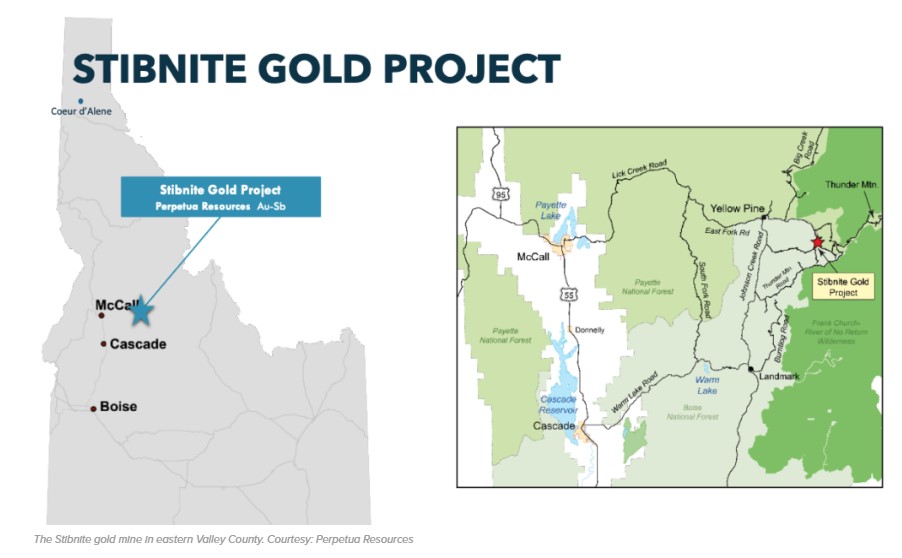
Stibnite Gold Project

17. November 2025 · Comments Off on Education – NOLS Wilderness First Aid – Idaho · Categories: Education, Safety

LINK TO WEB SITE


LINK TO PAGE

wfa-schedule-january-2025
2021_wm_student_agreement_rev_jan_2022

15. November 2025 · Comments Off on BCHI – March State Board Meeting & Convention · Categories: BCHI /BCHA, Education, Public Meetings

2026-BCH-Convention

12. November 2025 · Comments Off on Public Lands – SBFC Wildest Place Fall 2025 · Categories: Around The Campfire, Current Events, Public Lands


SBFC-Wildest Place_Fall 2025_Final-Web

11. November 2025 · Comments Off on Education: BCHC Education Pages · Categories: BCHI /BCHA, Education

LINK TO EDUCATION PAGE


LINK TO SAW PROGRAM PAGE

The BCHC saw program was the framework that the BCHI saw program was built. They were a great help in getting our program started.

31. October 2025 · Comments Off on Public Lands – Nov 2025 – Fix Our Forests Act · Categories: Current Events, Public Lands

READ FULL STORY:  Nov 2026 – Save Our Forest Bill

31. October 2025 · Comments Off on Education: Fall 2025 Idaho Wildlife Federation · Categories: Current Events, Education

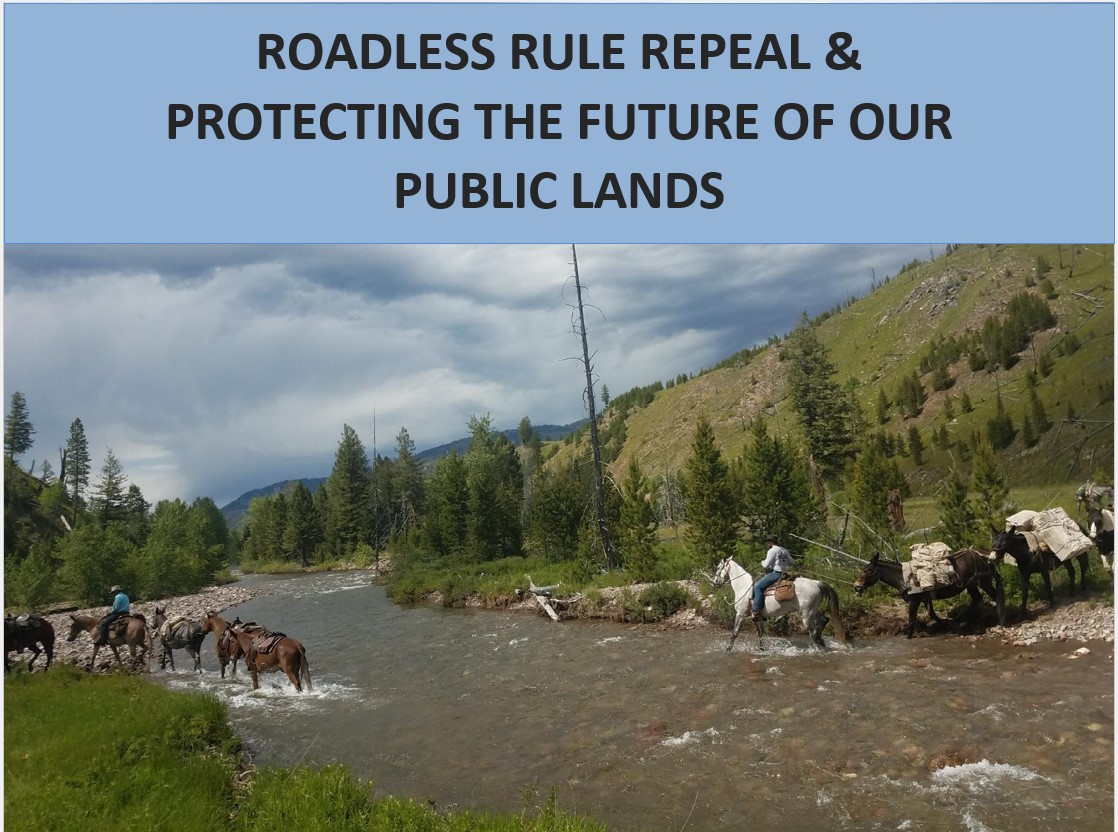
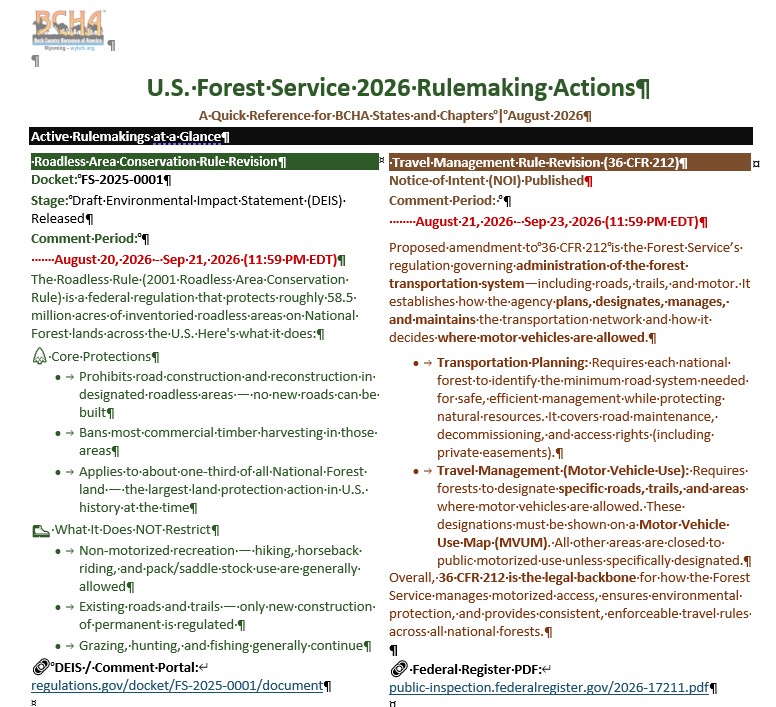
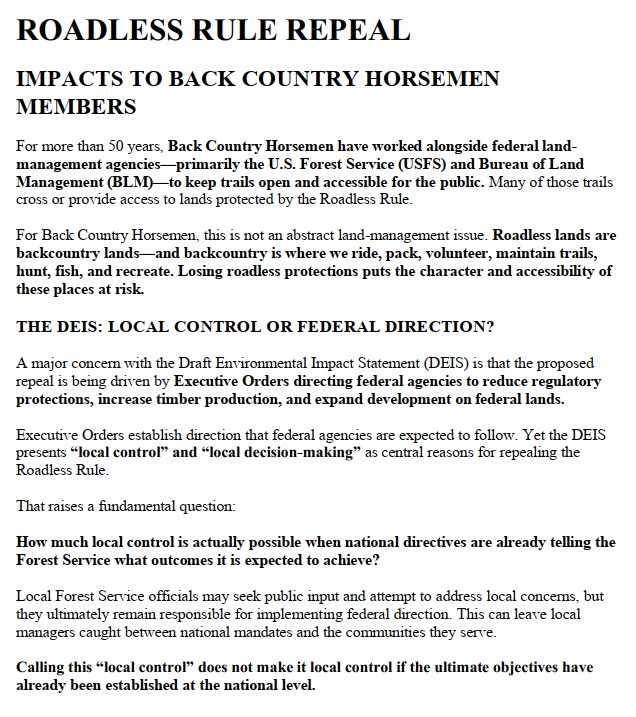
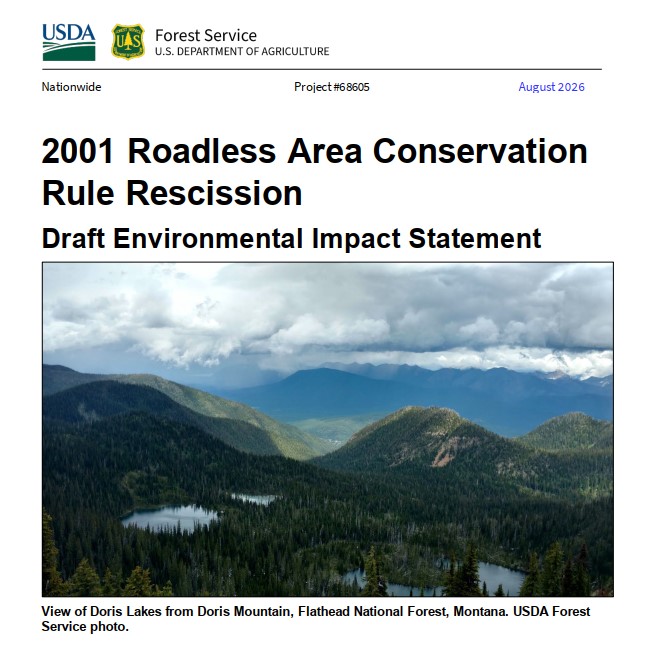
Idaho Roadless Rule (PDF)


Idaho’s Large Tracts Program

For many Idaho hunters, some of the best days in the field happen on private timber ground – chasing elk through foggy draws or hiking into a quiet clear-cut for deer at first light. Part of what makes that possible is the Idaho Department of Fish and Game’s Large Tracts Program.

This program is a partnership between Fish and Game and private timber companies that keeps large sections of private forestland open for public use. These are working timberlands – owned and managed for logging – but thanks to these agreements, hunters, anglers, and other recreationists can still enjoy access without needing special permission or paying a trespass fee. In return for allowing access, IDFG compensates enrolled landowners (at a much lower rate than they could get by leasing it exclusively to individuals) and conservation officers are able to enforce regulations and restrictions such as game laws and motor vehicle violations.

Most of these enrolled lands are found in north and north-central Idaho, home to some great whitetail, elk, bear, and turkey habitat. The rules are pretty straightforward, but every year, a few bad choices – driving around a gate, cutting firewood without permission, ignoring closures – risk leaving a negative impression of hunters on the landscape. These lands are private, and access is never guaranteed – especially if abuse or damage becomes a significant enough problem.

Following these rules is more important than ever in times of change. Since May of 2019, PotlatchDeltic – the largest landowner enrolled in the Large Tracts Program –  has allowed public access to 567,002 acres of their land. But just recently a merger has been announced between Potlatch and the Florida based company Rayonier to become the second-largest publicly traded wood commodities company in North America.

While there are many questions that are waiting to be answered, including the new name of the merged companies, one thing is for certain – we want the Large Tracts Programs looked at in a positive light to ensure these properties are able to be accessed by all, not leased to individuals or through paid permit system like much of the private timber ground in western Oregon and Washington.

Programs like this only work when we hold up our end of the deal. Respecting restrictions, packing out what we pack in, and reporting violations when we see them are small actions that make a big difference. They show landowners that Idaho hunters value the opportunity they provide.

The Large Tracts Program is proof that access and private property rights can coexist – when there’s trust and cooperation. So this season, as you head into your favorite patch of timber, remember: these lands aren’t ours, but the privilege to use them is. Let’s do our part to keep them open for Idaho hunters.

Heads up, deer hunters – EHD is affecting parts of the Clearwater. region Get the latest details and heat map from Idaho Fish and Game.  LINK TO MORE INFORMATION

30. October 2025 · Comments Off on Public Lands – Foothills Planting Day (updated) · Categories: Current Events


Wildfire has taken a toll on wildlife habitat in the Boise Foothills – but you can help restore it. This Saturday, join the Idaho Wildlife Federation, youth leaders from the community, and Idaho Fish & Game for a hands-on volunteer restoration day.

We’ll be planting Idaho native shrubs and grasses to stabilize soil, prevent invasive weeds, and improve habitat for mule deer, upland birds, and pollinators.

Join youth leaders, Idaho Wildlife Federation, and Idaho Dept. of Fish and Game to restore an area of the Boise Foothills that was burned during recent wildfire. We will be putting native plants in the ground and learning about our local ecosystem.

Please meet HERE at the Homestead Trailhead (3210 S Council Spring Rd) in Barber Valley. Turn onto Council Springs Road from Warm Springs. Park in the dirt area at the end of the road.

Wear clothes you don’t mind getting dirty and walking shoes. If you have accessibility concerns please reach out to us at climateaction@cityofboise.org. Please bring a water bottle. We will provide shovels and gloves.

Harriman Trail System Assessment

Existing Conditions Assessment

TRAIL MANAGEMENT PLANNING PROJECT

HTS Existing Conditions Assessment Report Spread

27. October 2025 · Comments Off on American Heart Association releases new Fall 2025 recommendations · Categories: Around The Campfire, Education

WATCH VIDEO

25. October 2025 · Comments Off on Public Lands – Harriman State Park Update · Categories: Current Events, Public Lands, Public Meetings

FHSP November Open House Invite Flyer

Existing Conditions Assessment Open House:

The Friends of Harriman State Park (FHSP) is hosting two open houses on Monday, November 10, to update the public on its ongoing trail planning project for the park.

CRO Planning and Design was retained by FHSP in September 2024 to conduct a 21-month research project that will culminate in a new Trails Management Plan for the park.

The consulting firm has now completed an “Existing Conditions Assessment” that describes current trail conditions, critical wildlife habitat, and perspectives from both winter and summer trail users.

New trail maps are featured that geolocate areas of highest use and conflict as well as unauthorized, user-defined trails.

Specific recommendations for future trail design, use and maintenance will be derived from Assessment findings, so agency and public input is critical at this stage. Project partners include:

  • Idaho Department of Parks and Recreation
  • Idaho Department of Fish and Game
  • Caribou-Targhee National Forest

How to Participate in the Open House

We welcome anyone interested to attend the following open house events taking place on Monday, November 10:

  1. Island Park: 12-2 p.m. @ the Fremont County EMS Building (4395 County Circle, Island Park, ID) (Google Maps Directions )
  2. Idaho Falls: 6-8 p.m. @ the Centennial Conference Room of the IDFG/IDPR Regional Office (4279 Commerce Circle, Idaho Falls, ID) (Google Maps Directions )

We are excited to share information and hear your perspectives about the project’s existing conditions assessment, a robust data collection process to gain insights on current physical, managerial, ecological, and visitor use conditions related to Harriman’s trails. These will be drop-in events, so feel free to visit any time during the two-hour periods. Opportunities for feedback about Harriman’s trails and the project will be available at this event.
Click here to RSVP to the open house events!

What if I Cannot Attend the Open Houses?

If you cannot attend the open house, we encourage you to view the virtual open house website, which will share the same information and opportunities for feedback as the in-person open house. Virtual open house materials will be available starting Monday, November 10, and will remain open until December 1.

Friends of Harriman State Park Grant Updates:
To help with future trail rehabilitation, the Friends of Harriman State Park intends to apply for FY2027 grants under these two funding programs administered by the Idaho Department of Parks and Recreation:

Recreational Trails Program (federal)

Mountain Bike Plate Fund (state)


Thank you and have a great weekend,

Brett Rannow, MS (he/him/his)
Associate Planner
715.204.6876

Brett@CROplanning.com

www.CROplanning.com

22. October 2025 · Comments Off on Education – Defensive Horsemanship · Categories: Education


ONLINE (HTML)     DOWNLOAD (PDF)


USFS Defensive Horsemanship Manual (pdf)  /   BCHA Mountain Manners  (pdf)

22. October 2025 · Comments Off on Trail Work – ITA 2025 Roundup · Categories: Current Events, Public Lands, Work Parties and Projects

11. October 2025 · Comments Off on Education – Attaching a Rifle Scabbard, Bow Scabbard or Camp Tool Scabbard to your Saddle · Categories: Around The Campfire, Education


Rifle Scabbards

I personally hang my rifle scabbard on the off-side of the horse. I attach it with the rifle butt toward the front at about horn height, and angle the rifle barrel slightly toward the back.

Here’s why:

The barrel of the rifle extends under my stirrup leather and I never know it’s there. This keeps the weight on the front quarters of the horse where he can carry it best. On the off chance I should spot game while in the saddle, I can pull my rifle out before I dismount. Hanging the shotgun scabbard or rifle scabbard on the off-side can help offset your weight when mounting.

One additional note, if you use an open ended leather or nylon rifle scabbard and hang it with the butt toward the rear, your rifle could end up missing. I have heard many stories where folks have found their rifle way back on the trail because they never knew it had been snagged on a branch and yanked out of the gun scabbard.

Pack Saws and Camp Axes

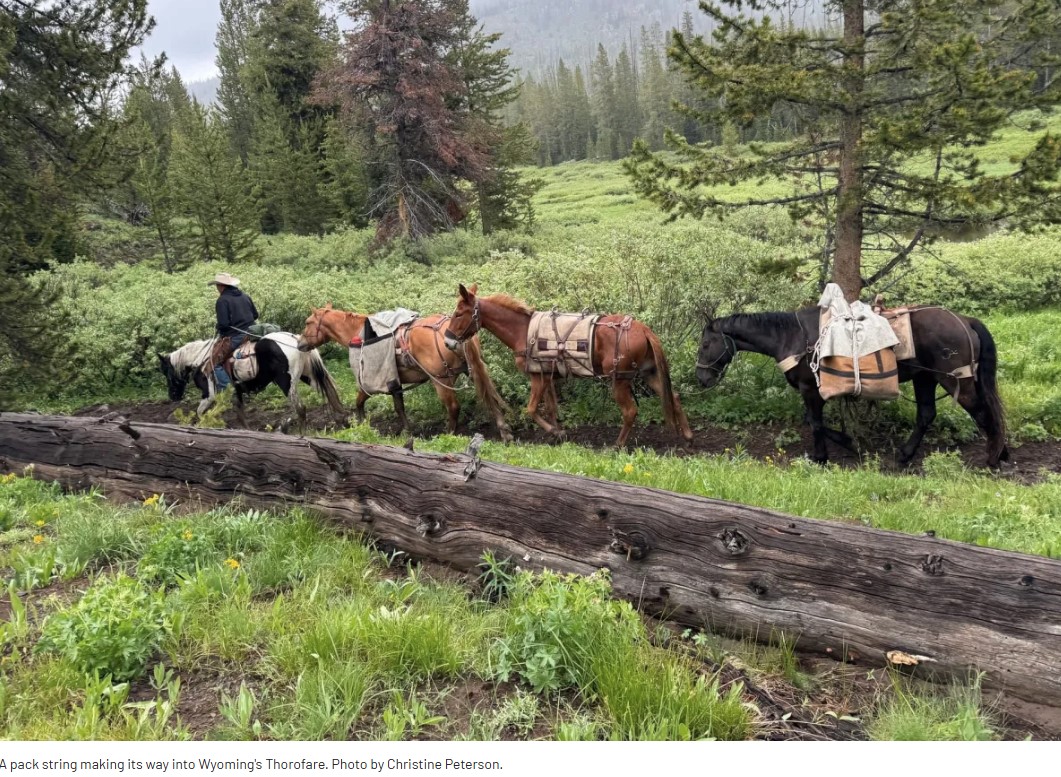
When I attach my pack saw and its scabbard or my camp axe in its sheath. I prefer to attach my saw scabbard with the saw handle tied to the front strings and the blade coming just under my leg. I usually pack my camp axe on my pack mule to the outside of a mantied load, but you can certainly attach it to your saddle if you prefer an axe. An axe sheath is designed with rings to tie your saddle strings to. This hangs the axe at an angle where it is easy to secure the handle out of your way.

Bow Scabbards

When hanging a Bow Scabbard, I secure it to the rear of the saddle behind the cantle and angle it slightly forward so that my bow is facing toward the rear with the quiver to the outside. I prefer this attachment method because with the bow scabbard pointed toward the rear, my horse is free to turn tightly to the right without being hindered by the bow. And once again, the weight of the bow and bow scabbard are on the opposite side from me when I mount the horse, helping to offset my weight as I mount.

Pack Saws & Axes

How do I hang a pack saw on my saddle?
One sure way to secure a saw to your riding saddle is to tie the pack saw handle with the rear saddle strings and then secure the blade under your leg. However, the pack saw scabbard has a versatile design that would allow you many options. Whichever way you choose, remember to offset the added weight of your saw by loading your horse saddlebags or horn bags heavier on the opposing side.

Why do I need to carry a pack saw or a camp axe with me on the trail?
The obvious answer here is for windfall blocking the trail. It is not always possible to go around a windfall, nor would you necessarily want to get into that habit; the new trail you would create only adds to the erosion of a potentially fragile area. It is better instead to simply clear the trail. Read the article “Pack Saws and Camp Axes” for a full explanation of why it is so important to carry a pack saw when you are out on the trail.

09. October 2025 · Comments Off on Education – NWCG Incident Response Pocket Guide · Categories: Education

(PDF)  pms461

07. October 2025 · Comments Off on USFS Update during the Government Shutdown! · Categories: Current Events

2025-10-03 Lapse In Appropriations Partner Letter

07. October 2025 · Comments Off on BCHI – 2027 Calendar Photo Instructions · Categories: BCHI /BCHA

Squaw Butte Photos will be collected by Rob Adams and submitted as a package the last week of November 2025.  If you have one you want considered, it must be a JPG and full size off your phone or camera.  Email it to moosely.adams@gmail.com with calendar photo in the subject line.

2027 calendar submission instructions

30. September 2025 · Comments Off on Education – Packing Check List · Categories: Education, Horse Camping, Tips, Tricks and Tid Bits

24. September 2025 · Comments Off on Education – Using a USFS channeled radio · Categories: Education, Safety

Watch Video

2023 Radio User Training Short      //    2025 Idaho R4 USFS Radio Channels

     Printable NIRSC Basic Wildland Fire Radio Training

Radio Procedures and Etiquette 2020

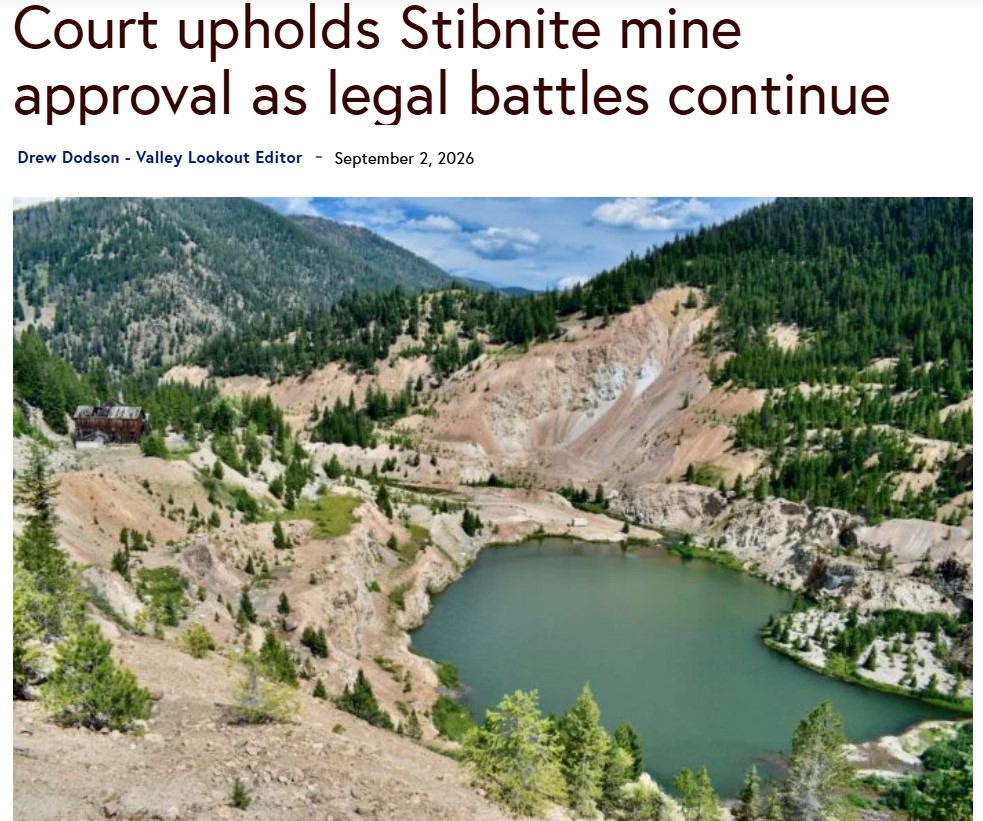
22. September 2025 · Comments Off on Public Lands – Proponents tout Idaho gold-antimony mine as lawsuits threaten its prospects · Categories: Current Events, Public Lands, Public Meetings

In the face of mounting legal challenges, the corporate backers of a gold and antimony mine in Central Idaho hosted state and federal dignitaries Friday at the remote site to celebrate recent approvals that have advanced the multibillion-dollar venture — which is at least another three years from operations.

The occasion, labeled a “ribbon cutting” by Perpetua Resources, the mining company behind the large-scale project, was more than eight years in the making. The U.S. Forest Service took that length of time before giving its blessing for the open-pit mine in the Payette National Forest mountains east of McCall — a point of frustration about such permits for Idaho’s federal lawmakers, who have all fully endorsed the project. Perpetua earned federal approval in January to reopen the abandoned site near the community of Yellow Pine, which has been mined off and on dating to the late 19th century. The publicly-traded Canadian gold mining firm, now with its headquarters in Boise, spent handsomely to push what it called the Stibnite Gold Project through the demanding environmental review process. “After eight years of extensive permitting review and over $400 million invested, it is finally time for the Stibnite Gold Project to deliver for America,” Jon Cherry, Perpetua’s president and CEO, said in a news release. “A united vision to produce critical resources urgently needed for national security and to restore an abandoned site, along with the feedback from our communities, have guided us to this monumental milestone.”

At the ceremony Friday, Cherry and other speakers promoted the mine’s importance in delivering the most shovel-ready domestic reserve of antimony in the U.S., including for its use in national defense, the company said in a report of the event. The critical mineral is needed for munitions, including missiles, some nuclear weaponry and other military equipment like night-vision goggles. “This mine offers a secure, reliable, domestic resource for military-grade antimony sulfide and is aligned with the Army’s ongoing ‘Ground-to-Round’ assured munitions strategy for establishing a complete domestic supply chain — from raw material access to material processing to ammunition production — as we modernize and fortify the ‘Arsenal of Democracy,’ ” U.S. Army Maj. Gen. John Reim told attendees. Antimony also is used in clean-energy technologies, including liquid-metal batteries, and for purifying glass in solar panels.

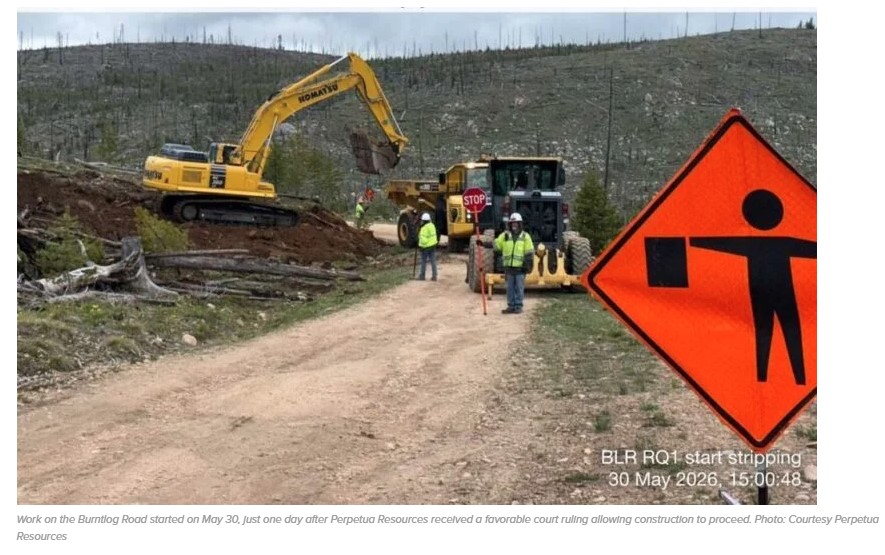
Perpetua also announced Friday that it obtained the Forest Service’s permission to begin initial construction in the near future, contingent on securing project financing. That’s expected to be in place “in the coming weeks,” the news release said. But lawsuits cloud the current mining plan and timeline, which envisions about 15 years of operations. Years more would then be spent cleaning up the site, including restoration of historical habitat where salmon spawn along the Salmon River. Perpetua has reported spending more than $20 million already to improve water quality and clean up legacy waste from past mining at the site.

The Nez Perce Tribe holds exclusive treaty rights to fish, hunt and gather on the land where the mine is planned. The tribe’s original agreement is from 1855 — predating both the U.S. Mining Law of 1872 and Idaho statehood in 1890. Last month, the Nez Perce sued in federal court to overturn the Forest Service’s decision to grant final approval to Perpetua. The mine would restrict access to its tribal members, on top of creating heightened risks of mine runoff entering into the headwaters and decreasing dwindling fish populations, according to the lawsuit. “The Forest Service dismissed our requests to consider alternative approaches that would avoid and minimize harm to our treaty rights and life sources and instead adopted Perpetua’s goals and interests for the mine,” Shannon Wheeler, the Nez Perce’s tribal chair, said last month in a statement. “We are filing suit to force the Forest Service to address the mine’s enormous and long-term degradation and destruction to our treaty life sources, and to honor our reserved right to fully and freely exercise our treaty fishing, hunting, and gathering rights as the U.S. government promised over 170 years ago.” Earlier this year, several conservation groups sued in federal court over their own environmental worries from Perpetua’s proposal to mine the old site in a rugged part of Valley County. The lawsuit cited concerns that the project would use toxic chemicals to extract gold, which could harm sensitive ecosystems and salmon near the border of the Frank Church-River of No Return Wilderness.

Perpetua has signed on as a defendant in both lawsuits, which are in their early stages. State permits pending The mine still requires two more state water quality permits in order to proceed, and also has a state air quality permit tied up in litigation. On Thursday, an Ada County judge sided with the environmental nonprofits the Idaho Conservation League and Save the South Fork Salmon in a lawsuit against the Idaho Department of Environmental Quality for its approval of that permit. The state agency sought to dismiss the legal claim on procedural grounds, but now the suit is scheduled to play out this fall. Anna Marron, spokesperson for the Department of Environmental Quality, declined to comment Friday, citing active litigation.

Perpetua anticipates the mine would create nearly 1,000 jobs during construction and more than half that total for operations. Idaho Gov. Brad Little, who attended Friday’s event, offered his support for the enterprise. “Idaho is proud to celebrate this milestone with Perpetua Resources and showcase the ways we are moving forward valuable projects that create hundreds of good-paying jobs that support Idaho’s rural economy,” Little said. “These jobs will allow Idaho’s young people to build rewarding careers right here in the communities of the west-central mountains.”

Preliminary construction, including road and power upgrades, is expected to get underway next month, Cherry told the Valley Lookout. Controlling shareholder: ‘A dream come true’ Friday’s ceremony drew skepticism from opponents of the mine, given that much remains to be resolved — including in the courts — for the project to move forward and begin digging. “There appears to be an element of theater involved,” Will Tiedemann with the Idaho Conservation League told the Idaho Statesman. “So as much as Perpetua does, this ribbon-cutting seems to be heavily influenced by marketing and appearance than the actual construction and permitting factors of starting construction — and when.” Perpetua said it intends for mining to get underway by 2029.

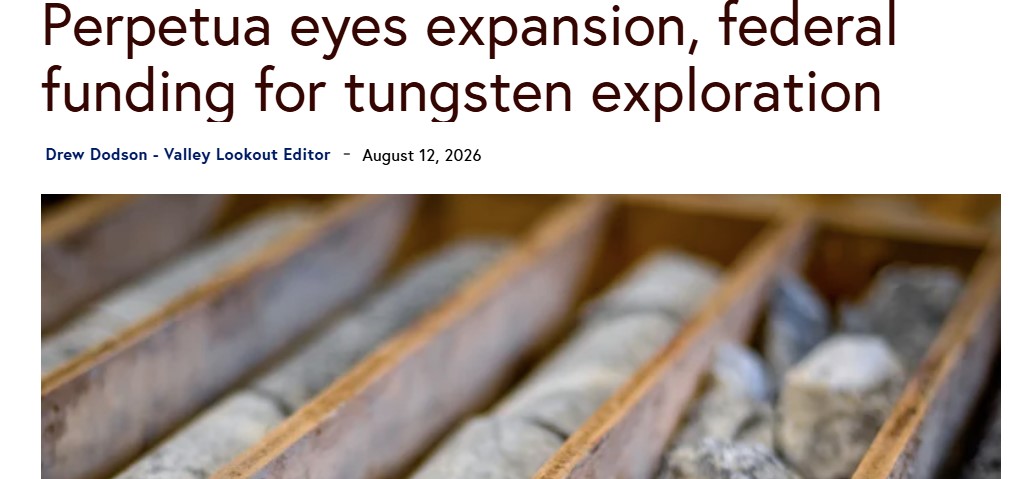
If that happens, the bulk of the 148 million pounds of antimony at the site would be prioritized during the initial years of operations, the company said. That amount is expected to supply only about a third of annual U.S. demand for six years, with the highest-grade material reserved for the military. The vast majority of profits from the mine, however, would come from its 4.8 million ounces of gold. A company-funded independent study from 2012 estimated about 93% of the project’s value derived from gold, while nearly 7% came from antimony and less than 1% from some silver at the site. Antimony would be produced as a byproduct from the excavation process, Cherry has acknowledged, in the company’s primary pursuit: building and operating a gold mine. In an investor call in June, the company’s controlling shareholder, billionaire hedge fund manager John Paulson, talked about the project exclusively in terms of gold. “

This almost is like a dream come true for us,” he said of the mine’s approvals toward possible operations. “But beyond the current mine plan, we think there is a lot of exploration potential in this site.” Today, with gold prices soaring to all-time highs, the site’s deposit is projected at nearly $18 billion. Antimony also has hovered at record prices this year, with current values placing the mine’s reserve at about $3 billion. To build and operate the mine project was estimated in 2020 to cost $1.3 billion. More recently, Perpetua applied for $2 billion in debt financing from the Export-Import Bank of the U.S., an independent executive branch agency. Perpetua expects its loan application to receive final bank review by spring 2026.

Read more at: https://www.idahostatesman.com/news/local/environment/article312145226.html#storylink=cpy