
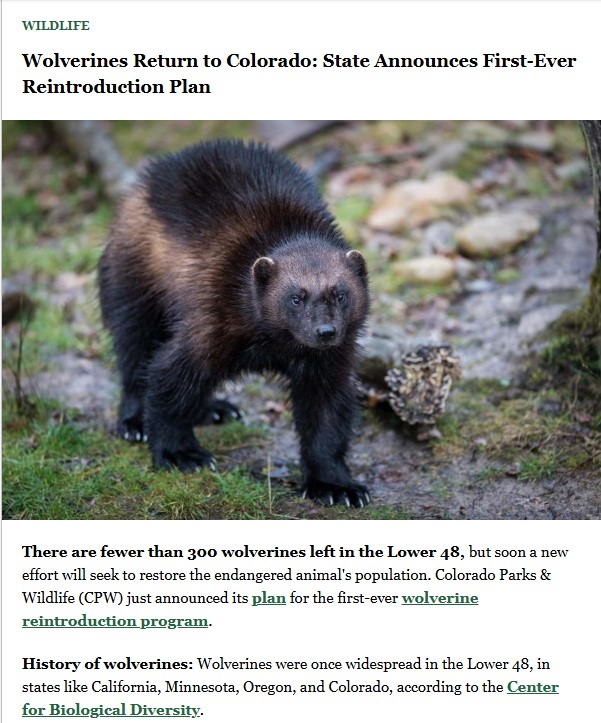
 There are fewer than 300 wolverines left in the Lower 48, but soon a new effort will seek to restore the endangered animal’s population. Colorado Parks & Wildlife (CPW) just announced its plan for the first-ever wolverine reintroduction program.
History of wolverines: Wolverines were once widespread in the Lower 48, in states like California, Minnesota, Oregon, and Colorado, according to the Center for Biological Diversity.
Since the early 1900s, the population has sharply declined, mostly due to trapping and habitat loss. In 2023, they were added to the Endangered Species List.
Why reintroduce? Beyond helping revive an endangered species, reintroducing the wolverine has other benefits. The animal is naturally an opportunistic scavenger-predator. In addition to hunting small mammals like squirrels and rabbits, they’ll eat leftovers from carcasses of sheep, caribou, and moose that other, larger predators have left behind.
As the nonprofit Defenders of Wildlife explains, “Wolverines play an important role as nature’s cleanup crew. By scavenging dead animals, they help recycle nutrients back into the ecosystem and reduce disease spread by eating carcasses.”
What’s the plan? According to CPW, over 94% of the planned reintroduction habitat is on federal land. The areas include parts of Rocky Mountain National Park, the Elk and West Elk Mountains, and the San Juan Range.
The department will release 15 wolverines per year for 3 years beginning in 2027. Depending on how the species fares, there may be more reintroductions. Since wolverines have very large home ranges, the state can support around 100.