February 5, 2025 – House Resource Committee Passed the Bill and recommends the Full House Pass it!

Nominated for: Secretary of the Interior
You might know him from: The 2024 Republican presidential primary. The former governor of North Dakota ran on his experience as a successful businessman before dropping out of the primary and becoming a vocal supporter of former President Donald Trump, then the front-runner, landing on the VP shortlist.
More about Burgum:
- He sold his software company to Microsoft in 2001 for $1.1 billion.
- He is a big booster of oil and gas drilling.
- He pledged for North Dakota to be carbon neutral by 2030, largely through carbon capture and storage.
- Position: The Department of the Interior oversees public and federal lands and their natural resources, the Bureau of Indian Affairs, the National Park Service and the Fish and Wildlife Service.
If confirmed as secretary of the interior, Doug Burgum would become a key player in implementing one of the Trump administration’s overarching goals: “Drill, baby, drill.”
The Department of the Interior manages roughly one-fifth of the lands and waters of the United States, giving Burgum — the former governor of an oil-rich state — significant leverage to increase domestic oil and gas production, which is already at an all-time high. But the massive department also oversees national parks and monuments, endangered species protections and relations with federally recognized Native American tribes.
During the first Trump administration, the Department of the Interior cut regulations to make it easier to drill on federal land, significantly weakened the power and scope of the Endangered Species Act and shrunk two national monuments. Deb Haaland, secretary of the Interior during the Biden administration, reversed many of these actions and focused on boosting conservation and renewable energy.
Burgum is expected to reverse course again. Burgum’s pro-drilling stance is fairly well established, and as Trump’s proposed head of the newly proposed National Energy Council — a body that will oversee regulatory processes across government agencies — he’d have considerable power to push fossil fuel extraction.
- READ MORE

The Supreme Court on Monday declined to take up Utah’s lawsuit aimed at wresting control of more than 18 million acres of public land in the state from the federal government.
In its lawsuit, filed in August, the state of Utah argued it was unconstitutional for the federal government to retain ownership of “unappropriated” lands, meaning those not set aside as a national park or for some other specific purpose. And it asked the court to effectively hand over 18.5 million acres of Bureau of Land Management lands to the state.
The conservative-led high court rejected the case outright, with no explanation. It’s a stunning defeat for Republican officials in Utah, who said they brought the case after “decades of legal analysis” and spent millions of taxpayer dollars promoting the legal effort.
“We’re grateful the Supreme Court swiftly rejected the State of Utah’s misguided land grab lawsuit,” Steve Bloch, legal director for the Southern Utah Wilderness Alliance, said in a statement. “For more than 100 years, the Supreme Court has affirmed the power of the federal government to hold and manage public lands on behalf of all Americans.” READ STORY / Salt Lake Tribune
A Utah conservation group has sued the governor and attorney general over the state’s U.S. Supreme Court public lands lawsuit.
The Southern Utah Wilderness Alliance, in a lawsuit filed in 3rd District Court Wednesday, argues that Utah Gov. Spencer Cox and Attorney General Sean Reyes violated Utah’s state constitution by taking their challenge of federal lands to the nation’s high court.
The group wants to stop the state from “dismantling a core part of Utah’s identity: public lands,” said Steve Bloch, SUWA’s legal director, in a statement.
“Utahns love their public lands,” Bloch said in a news conference Wednesday morning. “They’re not about to simply see them sold off or given up without a fight.”
2025 Legislation by Bill Number
The status of each bill, resolution, proclamation, and memorials listed on this page are updated when the offices of the Secretary of the Senate and the Chief Clerk of the House publish the un-official daily journals and should not be deemed official. The official bill actions are located in the final journal, which are maintained by the offices of the Secretary of the Senate and the Chief Clerk of the House. The daily journals are published at the end of each legislative day.
House Bills
Senate Bills
| (*) indicates previous days action (+) indicates ADOPTED or LAW |
Montana state officials have already made a New Year’s resolution: Sue the federal government. In a lawsuit filed on Dec. 31, Montana Governor Greg Gianforte accused the U.S. National Park Service (NPS) of violating established agreements for managing bison.
Federal wildlife officials have ignored Montana’s concerns about increased numbers of bison, the lawsuit said, and also avoided vaccinating the animals against brucellosis, a disease that worries the state’s cattle-ranching industry.
It’s the latest escalation in a decades-long conflict between state and federal officials over management of bison herds in Yellowstone National Park. The core issue is about how to manage the animals when they leave park borders and roam into Montana. According to the lawsuit, the NPS changed the rules regarding bison numbers and vaccination in a 2024 environmental impact statement without consulting state officials.
The lawsuit was filed in district court by Gianforte’s office, the Montana Department of Livestock, and the Montana Department of Fish, Wildlife, and Parks. The NPS didn’t immediately respond to requests for comment on Thursday.
“The new Bison Management Plan is another example of Yellowstone National Park’s tendency to do what it wants, leaving Montana to collect the pieces,” the lawsuit said.
READ FULL STORY
Uncle Sam has a belated Christmas gift for anyone who loves visiting national parks.
After years of political wrangling between state and federal officials, the U.S. Department of the Interior announced Monday the purchase of 640 acres of additional land within Grand Teton National Park. Known as the Kelly Parcel, the “picturesque landscape” has mountain views and “world-class wildlife habitat,” federal officials said in a news release.
The parcel was the largest remaining piece of unprotected land within the national park’s boundaries. By adding the area to the park, wildlife managers can maintain “essential connectivity for wildlife in the southern Greater Yellowstone Ecosystem,” officials said. They called the zone one of the last remaining temperate ecosystems on the planet that’s mostly intact.
The $100 million sale to preserve the parcel was made possible through a partnership between the Interior Department and the National Park Service. They pooled money from the Grand Teton National Park Foundation ($37.6 million), the Land and Water Conservation Fund ($62.4 million), and the National Park Foundation. But private donations were a big part of the conservation victory as well. Nearly 400 donors from 46 states made gifts ranging from $10 million to $15 million.
“We are in awe of the incredible generosity of hundreds of people who stepped forward to protect this essential parcel,” Grand Teton National Park Foundation President Leslie Mattson said.
Utah is no longer asking the U.S. Supreme Court to order the United States to “dispose” of 18.5 million acres of public land in the Beehive State, its latest court pleading shows.
In an 18-page Dec. 4 filing, Utah says its original complaint does not seek a sell-off or ownership transfer of the federal property. That complaint to the Supreme Court in August asked justices to “[o]rder the United States to begin the process of disposing of its unappropriated federal lands within Utah” — 18.5 million acres of land overseen by the Bureau of Land Management.
Utah filed more papers Dec. 4 that appear to back off from that demand for divesture.
“Utah is not ‘ask[ing] this Court to exercise … the power to dispose of public lands,’” Utah’s latest filing states. “Nor does Utah seek an order ‘direct[ing] Congress to enact new statutes,’” requiring the United States to shed its holdings, Utah’s latest document reads.
Instead, Utah’s lawyers contend, the state only wants the justices to declare unconstitutional the United States’ ownership of the property managed by the BLM. What the federal government should do after that, Utah’s latest filing doesn’t say.
The difference between the two filings marks a “seismic change” in Utah’s position, said Ryan Semerad, a Casper attorney practiced in public land issues. He has analyzed the Utah complaint in a 40-page paper submitted for publication to the Wyoming Law Review. He also successfully represented four hunters in an ongoing public access corner-crossing case in Carbon County.
Compared to Utah’s initial complaint, the latest filing is “a much softer request … a much weaker ask than the headlines have made out,” Semerad wrote in an email. “In the end, Utah just wants the Court to tell Congress that it must give the Secretary of the Interior more leeway to sell off or transfer lands, eventually.” READ MORE

BOISE, Idaho—With support from local partners and organizations, the Bureau of Land Management (BLM) has acquired the 320-acre South Fork Willow Creek area to connect, consolidate, and protect public lands in the Boise Foothills and Smoky-Boise Complex big game priority area with winter range for elk, mule deer, sage-grouse, and black bear.
The acquired lands add several miles of existing non-motorized trails accessible from the Avimor residential development for hiking, mountain biking, or horseback riding, as well as public access to Idaho’s most popular big game hunting area, Game Management Unit 39. This area also provides close and convenient access to open spaces for the public to encounter both wildlife and dynamic city views framed by the Owyhee Mountain Range.
“We are excited that the public will now have access to these additional acres,” said BLM Four Rivers Field Manager Brent Ralston. “Our partnership with the Land Trust of the Treasure Valley to acquire this parcel provides recreational opportunities and the outdoor lifestyle that people desire to have in a popular area like the Boise Foothills.”
The area is approximately 12 miles north of downtown Boise and provides continued public access near ongoing residential developments. The BLM purchased the land from the Land Trust of the Treasure Valley, a non-profit organization, using money from the Land and Water Conservation Fund.
by ERIC WELCH
Staff Writer | December 13, 2024 1:00 AM
In partnership with Stimson Lumber Company and the Idaho Department of Lands, nonprofit Trust for Public Land announced an easement agreement Wednesday that will protect 10,846 acres of working forests in Bonner and Boundary counties.
Under the agreement, IDL holds the development rights to land owned and logged by Stimson Lumber Company, ensuring the easement areas will not be subdivided and will continue to contribute to the local timber industry.
“By protecting over 10,000 acres of working forestland in northern Idaho, Trust for Public Land has ensured that these vital landscapes will be preserved for future generations,” said Trust for Public Land Northern Rockies Director Dick Dolan.
In a press release, IDL Director Dustin Miller and Stimson Lumber Company President Andrew Miller expressed their commitment to preserving working forests in the area and protecting the longevity of Idaho’s timber industry.
According to Sam McSherry, Trust for Public Land project manager, the value of the easement will become more and more apparent as time goes on.
“This is very much just establishing what’s already in place for down the road,” McSherry said.
To enable the agreement, Trust for Public Land worked to secure $7.7 million in federal Land and Water Conservation Fund money through the U.S. Forest Service’s Forest Legacy Program.
A portion of those funds were used to purchase the easement with Stimson Lumber Company, whose property value under an easement agreement shrinks due to the elimination of development opportunities for the landowner.
McSherry noted that dedicating timber land to be worked in perpetuity supports sustainable harvesting practices and jobs in logging and forest products production.
“The overall benefit that these projects can bring is economic support to these communities,” he said.
McSherry also emphasized the importance of safeguarding undeveloped land to protect the wilderness character of the area for use by residents.
“Another huge benefit of these easements in northern Idaho is preserving the public’s access to the backyards,” he said. “These are the areas that the community members rely on, and being able to protect those for the future is pivotal.”
Wyoming is backing an effort by Utah to wrest ownership of U.S. Bureau of Land Management land from the federal government, arguing that states could “develop the land to attract prospective citizens.”
In an amicus brief filed Tuesday, Wyoming, Idaho, Alaska and the Arizona Legislature expressed support for Utah’s quest to take its case straight to the U.S. Supreme Court. Utah wants to own BLM land that’s currently the property of all Americans, saying among other things that the federal holdings deprive the Beehive State of an equal footing with other states.
Gov. Mark Gordon announced the Wyoming plea this week. Wyoming’s U.S. Rep. Harriet Hageman lent her name to a separate amicus brief supporting Utah, teaming with U.S. Sens. Mitt Romney, Mike Lee and other Western members of Congress.
Twenty-six Wyoming legislators also asked Tuesday to join the action if the Supreme Court agrees to take up the issue. Those 10 state senators and 16 representatives (see list below) say they might not stop after gaining state ownership of BLM’s property which is largely sagebrush and desert prairie steppe.
Wyoming legislators’ could extend their claims to “all former federal territorial lands … now held by the United States … [including] parks, monuments, wilderness, etc.,” their brief states.
The federal government has until Nov. 21 to respond to what conservationists call a “land grab.”
“This lawsuit is as frivolous as they come and a blatant power-grab by a handful of Utah politicians whose escalating aggression has become an attack on all public lands as we know them,” Jocelyn Torres, an officer with the Conservation Lands Foundation, a Colorado nonprofit, said in a statement.
Unappropriated
Utah and its allies argue that BLM lands are “unappropriated” and should be the property of Western States. Because of the federal government’s “indefinite retention” of 18.5 million BLM acres, “Utah is deprived of basic and fundamental sovereign powers as to more than a third of its territory,” its bill of complaint states.
Sagebrush rebellion efforts like Utah’s legal gambit have popped up — and fallen short — repeatedly since the movement arose in the 1970s. They’ve been countered in part by western states ceding — in their constitutions at statehood — ownership of federal property to the government and all Americans.
“The people inhabiting this state do agree and declare that they forever disclaim all right and title to the unappropriated public lands lying within the boundaries thereof,” the Wyoming Constitution states. Further, Western states received federal property at statehood — two square miles in many surveyed 36-square-mile townships in Wyoming — to support schools and other institutions.
“Only Congress can transfer or dispose of federal lands,” the Lands Foundation said.
Gov. Gordon sees it differently.
“Wyoming believes it is essential for the states to be recognized as the primary authority when it comes to unappropriated lands within our borders,” he said in a statement Thursday.
The BLM manages 28% of the land in Wyoming, the brief states, most of it “unappropriated.”
Leaving vexing legal complexities to Utah, Wyoming’s brief focuses on “harms that federal ownership of unappropriated lands uniquely imposes on western States on a daily basis,” the amicus filing states. “In short, western States’ sovereign authority to address issues of local concern is curtailed, and billions of dollars are diverted away from western States.”
A ruling in favor of Utah would “begin to level the playing field … and restore the proper balance of federalism between western States and the federal government,” the brief states.
The Garmin inReach Messenger Plus delivers “almost flawless communication from the field via voice, text, and images,” she wrote in her review.
Key Takeaways:
-
Garmin brings its inReach connectivity to “a whole new level” with the capacity to send voice messages, images, and a huge leap in text length.
- Though the price is a bit steeper than its predecessors, it’s worth every penny to those who appreciate the new perks, Schrute.
Read the full story here.
Patti has been working with ITA since the very first project in 2010, first as a Forest Service trail leader and then as a volunteer crew leader. She has also helped as a crew leader teacher at our CLEM (Crew Leader Education and Mentoring) Training. Her long history working on trails and with crews (30 years!) in the Forest Service is a huge asset to ITA and we so appreciate her commitment to sharing her skills and experience by training leaders and volunteers! Thank you for all you do for Idaho’s trails, Patti! READ FULL STORY

Idaho Wildlife Federation Names Nick Fasciano New Executive Director
A dedicated advocate for Idaho’s wildlife and habitat, Nick brings a wealth of experience to the role. He previously served as the head of policy for the Idaho Chapter of Backcountry Hunters & Anglers, where he worked closely with IWF staff in the Idaho Legislature to ensure the voices of sportsmen and women were heard by our elected representatives.
Fasciano has been an active partner on a range of priorities central to IWF’s mission. He has advocated for the recovery of Idaho’s wild salmon and steelhead runs, worked to push land management agencies to include the latest science on wildlife migration corridors in land use decisions, and has been a consistent defender of public access to Idaho’s abundant public lands and waters.
“It has been a privilege to work alongside IWF in the past, and I’m thrilled to be coming on board as a member of the team,” says Fasciano. “Since its founding in 1936, IWF has been a leading voice for conservation in Idaho, and many of our most cherished wild places would simply not be here today without the dedication of IWF’s staff and supporters. It is the honor of a lifetime to help push that legacy forward.”
An avid hunter and angler, Fasciano is based in Boise where he is working to get his young lab, Corbett, ready for bird season.
Nick officially begins his tenure with IWF this week, Sept. 16th-20th. He can be reached via email at NFasciano@idahowildlife.org.
SAVE THE DATE: Save Nov. 7th on your calendar because we’re going to have a meet-and-greet, in Boise, where you can all get to know Nick better. Much more to come soon on that!

OGDEN, Utah, September 10, 2024—The USDA Forest Service announced that the Boise and Salmon-Challis National Forests will be allocated $8.8 million through a competitive internal process under the Collaborative Wildfire Risk Reduction Program. The funding aims to expand essential wildfire risk reduction efforts through partnerships that help protect valuable resources and strengthen cultural connections to the land.
The Collaborative Wildfire Risk Reduction Program, funded by the Inflation Reduction Act’s hazardous fuels dollars, targets National Forest Service lands within the wildland urban interface where national forests meet homes and communities.
“This significant investment from the Inflation Reduction Act enables us to address critical wildfire risks in our region, particularly in areas that have not received the focused Wildfire Crisis Strategy funding,” stated Regional Forester Mary Farnsworth. “By working with diverse partners, we are committed to making our forests more resilient and reduce risks to communities from the effects of uncharacteristic wildfire.”
Intermountain Region Highlights
Boise National Forest- Lowman Hazardous Fuels Reduction Project
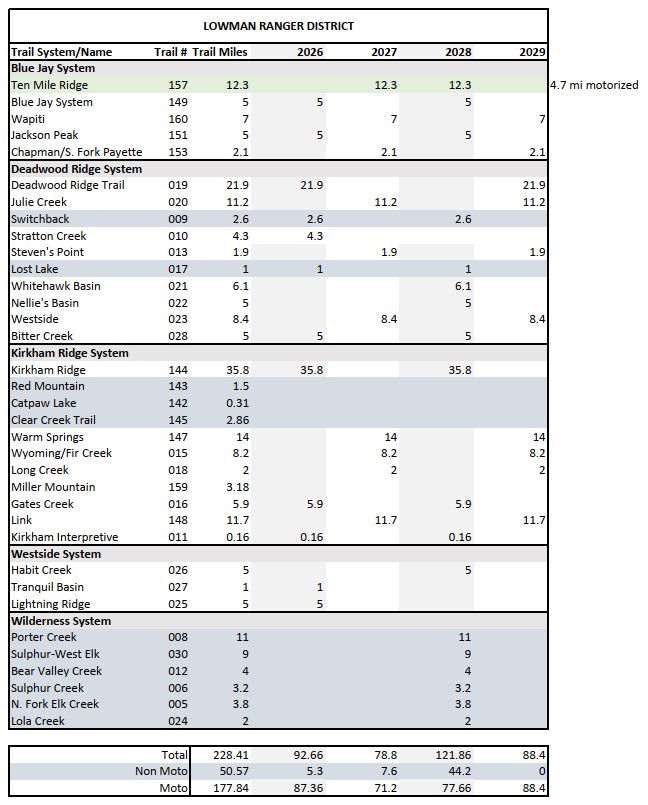
The project aims to treat 8,000 acres through a mix of prescribed fire, non-commercial thinning, and commercial timber harvest, enhancing Idaho Power infrastructure along the Highway 21 corridor for improved service reliability. Collaboration with the Shoshone-Paiute and Shoshone-Bannock tribes is being explored, involving tribal saw crews, with potential for utilizing leftover wood and wood products for the Wood for Life program. Local partners, including Idaho Power, Idaho Conservation Corps (ICC), Boise County, and the Lowman community, will actively participate in treatment preparation and execution, with the ICC providing youth crews for hands-on experience. The project is expected to reduce wildfire risk to communities and critical infrastructure as well as increase the wildlife resilience of the landscape, benefit the local economy, community, and foster sustainable land management practices through strong partnerships.
Salmon-Challis National Forest- Municipal Watershed to Panther Creek
This project is part of a larger 600,000-acre initiative aimed at reducing hazardous fuels and restoring critical landscapes. Specifically, it seeks to lower wildfire risk to the city of Salmon, protect a vital utility power line, create strategic fuel breaks, restore Endangered Species Act fish habitat, and enhance wildlife habitats. Supported by partnerships with the Mule Deer Foundation, Idaho Department of Lands, The Nature Conservancy, and the Student Conservation Association, the project will treat 10,500 acres through thinning and prescribed burning between fiscal years 2025 and 2027. The project will also involve local communities and workforce, offering employment opportunities and contracts to boost the local economy while ensuring vulnerable communities, like those near Panther Creek, benefit from reduced wildfire threats. Additionally, the project explores collaborations with the Shoshone-Paiute and Shoshone-Bannock tribes for using leftover wood and plant materials for energy or community firewood programs, reinforcing the commitment to public safety, sustainable land management, and strong community partnerships.
Criteria for eligible areas/projects include:
- Areas outside the 21 wildfire crisis landscapes
- On National Forest System lands
- Meet the Healthy Forest Restoration Act – Wildland-Urban Interface definition
- Are within high-risk firesheds identified in the Forest Service Wildfire Crisis Strategy and/or are areas with very high wildfire hazard potential
Anyone interested in learning more about this internal process can visit the Collaborative Wildfire Risk Reduction webpage.
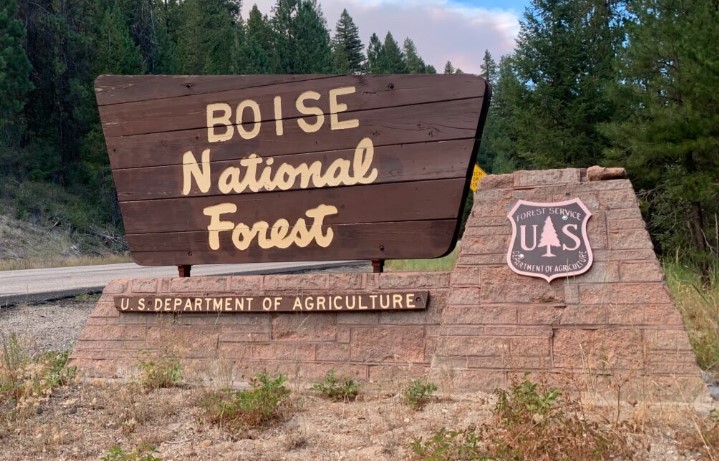
Discover the lands of the Boise National Forest and its 2.5 million acres of mountains, valleys, rivers, lakes and grasslands, more than 500 trails, and over 250 lakes and reservoirs.
The Salmon-Challis National Forest spans over 4.3 million acres in east-central Idaho, encompassing diverse habitats ranging from rugged mountains and deep canyons to pristine rivers and expansive wilderness areas.
Follow us on Facebook: Boise National Forest, Salmon-Challis National Forest, and on X: Salmon-Challis National Forest, Intermountain Region.
You can learn more about the Wood for Life program through this video and story.
For imagery visit the Collaborative Wildfire Risk Reduction Program Flickr album.
The U.S. Forest Service has not yet approved a plan to allow electric bicycles (e-bikes) on trails in the Lake Tahoe Basin, contrary to earlier reports. The Lake Tahoe Basin Management Unit (LTBMU) is still in the process of evaluating a proposal that could potentially open up more than 100 miles of trails to e-bikes.
The Basin Wide Trails Analysis Project, which includes the e-bike proposal, is currently undergoing environmental assessment. The Forest Service expects to release the Final Environmental Assessment and a Draft Decision Notice in late August 2024. This will be followed by a 45-day administrative review period for those who have previously commented on the project and have standing to object.
If approved, the plan would allow Class I e-bikes, which are pedal-assisted and can reach speeds up to 20 mph, on designated trails. The proposal also includes the potential construction of new routes and upgrades to existing infrastructure.
The LTBMU received 660 comment letters during the public comment period in September 2023 and has been working to update the Environmental Assessment based on this feedback. The agency is also completing a required formal consultation with the U.S. Fish and Wildlife Service.
Currently, e-bike use is only permitted on National Forest roads and trails in the Tahoe Basin that are designated for motor vehicle use, in accordance with the Forest Service’s Travel Management Rule.
A final decision on the project is estimated to be released in November 2024. This timeline reflects the complex nature of the proposal and the Forest Service’s commitment to thorough environmental assessment and public engagement in the decision-making process.
https://www.fs.usda.gov/detail/ltbmu/news-events/?cid=FSEPRD1192762
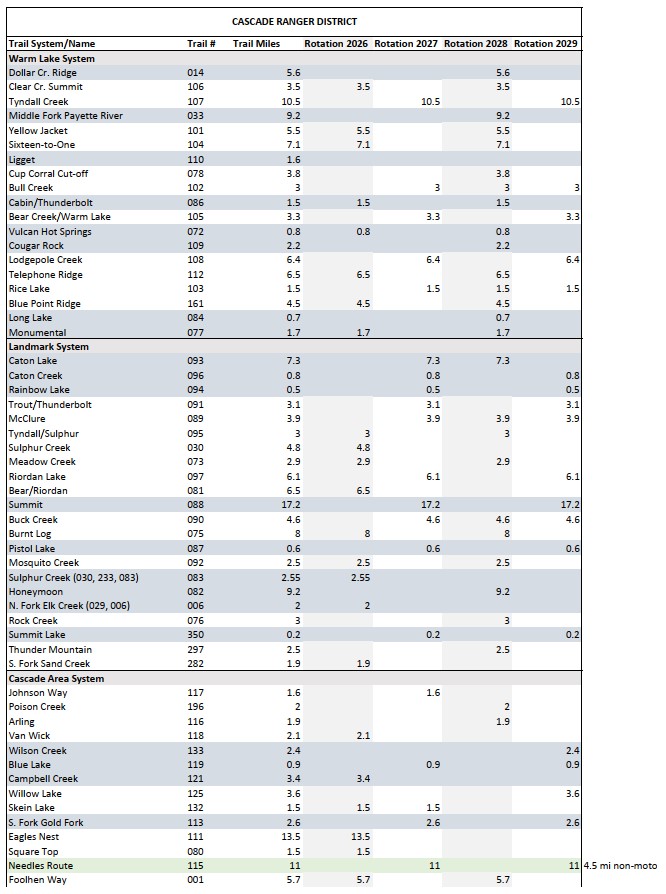
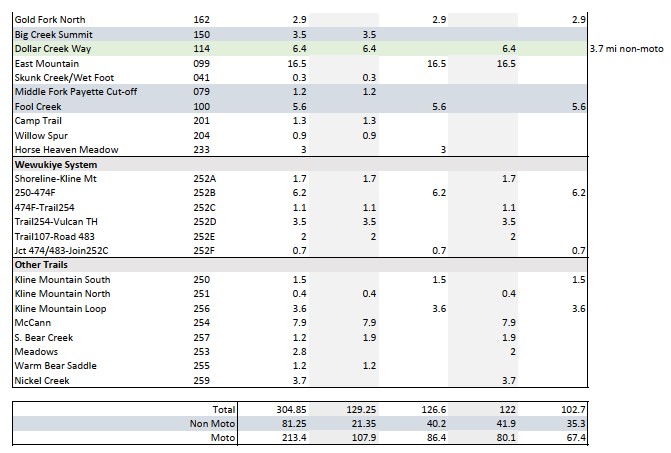
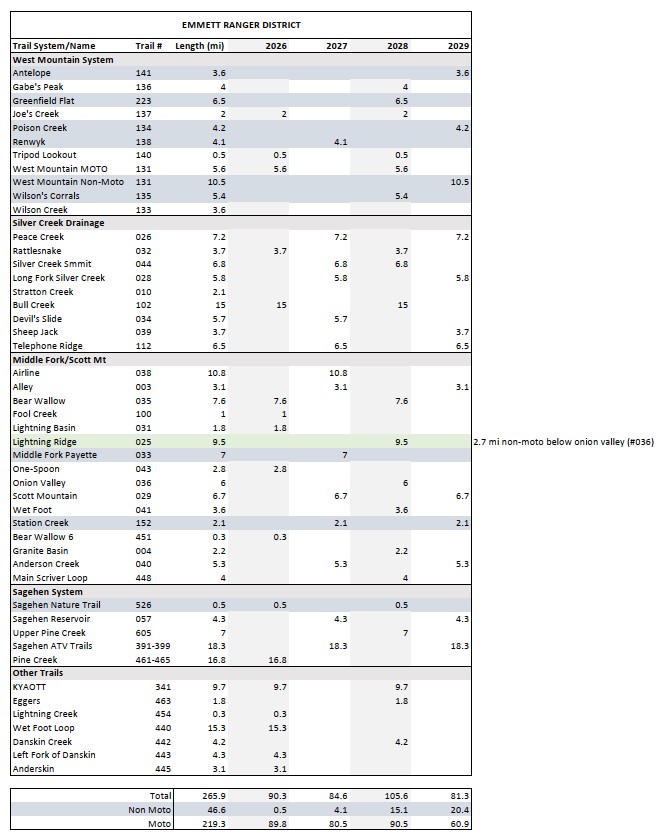
Just wanted to let you know where we are after three weeks of work done, and the rough plan I have for the remaining three. I have a bunch of pictures attached here and can send more if needed.
We have had a crew work on each of Renwyck, Antelope, and Gabe’s Peak. Progress has varied on each trail. Renwyck and Gabe’s Peak were fairly easy going for the first two miles before getting brushy and hard to find. Antelope got brushy and off-track very quickly. I actually ended up going out last week to visit the crews and find/flag the Antelope trail a little further out.
On the specs sheet, it lists Renwyck and Antelope as higher priority, so I was going to have the remaining three weeks focused on those two trails. I think I will likely need to visit the site again to flag both these trails further – unless you or someone on the trail crew can go do the same.
For Renwyck, the crews will basically be building new tread from where they left off. The old tread is there but very intermittent and not easy to follow. The nice thing here is that the trail does follow closely to the FS Quad Topo map and Avenza will be helpful in finding where to build going forward. I was planning on having two of the remaining weeks here.
For Antelope, the line on the Topo map is very wrong and this actually ended up hurting the crew as they went a good ways off tread trying to match that line. I got them back on the right track but would be surprised if they make it much past two miles, if that, with the one remaining week of work.
For the photos, the first four (0486, 0483, 0491, 0492) are work done on Antelope. The next two (0506 and 0507) are work done on Renwyck. The last (0494) is a good approximation of what both trails look like going forward – this particular picture is Antelope.
Let me know if this makes sense as the plan going forward. We’ll have a crew out that way next week (thinking Antelope for this) and I would love to hear back if you have any differing ideas.
Thanks,
Oliver Scofield
(he/him/his)
Program Coordinator
Idaho Conservation Corps

BOISE, Idaho — The Idaho Transportation Department (ITD) has announced its plans to begin soil testing underneath the historic Rainbow Bridge on Highway 55, to collect data for future construction plans for a new bridge.
According to ITD, the bridge has been standing since 1933 and no longer meets current highway safety standards. Environmental and design planning began last spring, but ITD will begin drilling in 18 locations around the existing bridge this June to collect samples.
“Prior to the drilling, ITD will remove trees and vegetation near each drilling location to allow a helicopter to safely lower equipment,” officials said. “The ground will be re-seeded after drilling. Results will be used for designing the bridge foundation, supports and retaining walls along State Highway 55.”
The Idaho Transportation Department said the project would also decide the future of the existing bridge, adding ITD wanted the process to be as transparent as possible.
“Public input will be a key consideration in the final recommendation for the new bridge and the existing bridge,” ITD’s Dan Gorley said.
Sampling will last throughout June, and ITD said drivers should expect 15-minute delays as officials will be drilling. However, work will stop for the weekend at 12 p.m. each Friday.
Construction of the new bridge is expected to start in 2027 or 2028, ITD stated.

The Latest News on Idaho’s Public Lands
Our work reviewing project proposals and permits—both exhaustive and sometimes exhausting—pays off in big ways.
The Idaho Board of Environmental Quality recently issued a decision invalidating Perpetua Resources’ air pollution permit for the proposed Stibnite Gold Mine. The Board found that Perpetua Resources and the Department of Environmental Quality (DEQ) failed to follow regulations designed to protect people from arsenic-laden dust. The decision remands Perpetua’s air pollution permit, sending it back to the administrative hearing officer to reconsider ways to better control arsenic emissions and reduce cancer risks from the proposed mine.
In response to another protest by ICL and our partners, a Hearing Officer with the Idaho Department of Water Resources (IDWR) also established minimum stream flows to Perpetua’s water withdrawals that are more protective of fisheries.
Finally, if you care about the four million-acre Nez Perce-Clearwater National Forest in north central Idaho, then you’ll be interested to learn about the status of the Forest Service’s efforts to revise the Land Management Plan.
ICL participated in a three-day administrative hearing to voice objections to the agency’s near-final new plan, arguing that it would harm wildlife, wildlands, and wild rivers by increasing off-road vehicle and snow machine access while shrinking the boundaries of the proposed Great Burn Wilderness Area. The Forest Service has also preliminarily stated that the North and South Fork Clearwater Rivers are not “suitable” for protection under the Wild and Scenic Rivers Act. It is unclear how the Forest Service will respond to the objections of ICL and other conservation groups, but a written response is due to be published sometime in June. Until then, stay tuned!

This fall, deer hunters will follow new testing rules for chronic wasting disease management.
The new mandatory testing requirements apply to several hunting units in Central Idaho near U.S. 95/ Highway 55 south of Grangeville. Testing helps prevent the spread of CWD and it will let hunters know if the meat is safe to eat.
In March, the Fish and Game Commission made several changes, including:
- Adding Unit 18 to the CWD Management Zone. Now the zones include Units 14 and 18. Unit 15 was removed. If you are hunting in the zones listed above, there are special rules to follow found here.
- Testing of whitetail deer and mule hunted in Units 23,24, and 32A is now mandatory—whole carcasses can still be removed from those units.
- There is no longer a testing requirement for mule and white-tailed deer, elk, and moose harvested in Unit 15 and moose and elk in Unit 14.
According to Fish and Game, CWD was first discovered in Idaho in 2021. The fatal disease affects deer, elk, and moose. Symptoms of CWD in wildlife include excessive salivation, trouble swallowing, and excessive thirst. It stays indefinitely in the environment.
No moose has tested positive and only two elk. Wildlife managers are not as concerned about those animals at this point.
“If ignored, CWD will infect new areas, cause more sick animals, and eventually result in fewer deer, the Fish and Game news release said. “Although elk and moose are less susceptible, CWD will also spread to them.”

Jobs & Internships |
|
|
| Wilderness Fuels Module Crew Leader – Sierra Institute
Wilderness Fuels Module Assistant Crew Leader – Sierra Institute Wilderness Fuels Module Sawyer Crew Member – Sierra Institute Wilderness Fuels Module Crew Member Medic – Sierra Institute Stewardship and Outreach Manager – New Mexico Wild Wilderness Ranger – New Mexico Wild Nancy Morton Wilderness Intern – New Mexico Wild Trail Crew Member – Roaring Fork Outdoor Volunteers Wilderness Trail Crew Members (waitlist) – Friends of Nevada Wilderness |
Did you feel yesterday morning’s earthquake?
According to the United States Geological Survey, there were several. The first one, and the strongest, hit at 10:25 a.m. and had a magnitude of 4.9. It registered about six miles North of Smiths Ferry with light shaking reported in the Treasure Valley.
USGS recorded an aftershock of 2.7 magnitude at 10:45 a.m. about five miles Northwest of Smiths Ferry. Another aftershock of 2.8 magnitude about three miles Northwest of Smiths Ferry was recorded at noon.
The Idaho Transportation Department said there was rockfall in the roadway near where the earthquakes occurred but there is no indication of damage. To be sure, ITD said its crews are assessing roads, culverts, and bridges, including Rainbow Bridge, in the area.
“In the event of any damage resulting from the earthquake, ITD will provide prompt notification to the public,” ITD said in a news release. “ITD wants to reassure the community that every measure is being taken to assess and address potential safety risks from this earthquake, demonstrating our unwavering dedication to maintaining a secure transportation network for all.”
Monday’s quakes occurred in the Western Idaho Seismic Zone, which lies between Boise and McCall. The zone includes active faults such as the Long Valley fault zone and the Squaw Creek fault.
Comment period for the Boise National Forest’s Sage Hen project is open up to February 20.
Follow the first link below then click on the “Comment/Object” link on the right side of the page to enter or upload your comments.
Sage Hen has a limited amount of Recreation proposals in the Plan as-written, but the opportunity is still open to get on-record with suggestions.
Specifically, the district ranger has offered to consider ideas that can fit well into the existing plan scope. For instance, there could be an opportunity to utilize some of the proposed closures of road spurs for parking and walking trails. If you have any specific ideas, please comment and provide details.
Please note: This Plan is not at the final Decision Notice stage, so this is the time to get your comment in if you want to be eligible to participate during the subsequent Objection phase of the process.
Basic Analysis:
• https://www.fs.usda.gov/project/boise/?project=56701
• Map centered on Project Area: https://arcg.is/iXv0y0
• Groomed OSV routes may be plowed during veg activities, coordination with Valley Co. grooming and IDPR is in the plan.
• 8.2 mi of currently-open primitive road are proposed to be closed to public motorized use. An appropriate comment would be to suggesting conversion to recreational trail particularly if such routes create loops (see maps at Project site).
• 1.0 mi Tr389 of <50″ trail is proposed to be decommissioned: Let FS know why you object or if you have an idea for a replacement trail to offset the loss.
• 5.6mi of routes are proposed to change from open-year-round to seasonal public access.
• Renwyck Creek Trailhead is proposed to be redeveloped and CXT toilet added. See https://arcg.is/5benz
• A reduction of available Authorized Dispersed Camping is proposed along NFR614.
• Fun fact: Sage Hen is home to the KYAOTT Trail. KYAOTT means “Keep Your ATV On The Trail.”
• Sage Hen Area Recreation Brochure: https://www.fs.usda.gov/Internet/FSE_DOCUMENTS/stelprdb5286976.pdf
Notable excepts from the Revised Environmental Assessment & Finding of No Significant Impact statement for the Plan (emphasis added):
Pg 11
Existing conditions are also negatively affecting areas within and between habitat patches for wildlife. Species sensitive to motorized vehicle disturbance or vulnerable to road-associated mortality are most impacted. Impacts from the spread of noxious weeds along these corridors and erosion on bare ground are other consequences of unauthorized use (see Figure 14).
Pg 12
Purpose 3: Recreation Use
[There is a need to …] Enhance recreational experiences while reducing potential for resource degradation and manage dispersed and motorized recreation to reduce user conflicts.
Need for Management Actions
The project area is one of the more popular recreation destinations on the Emmett Ranger District. As the population in the greater Treasure Valley has increased, the recreation facilities around the Sage Hen Reservoir are often at capacity. Some dispersed camp sites along National Forest System Road 614 have been encroaching into designated campground developed sites around Sage Hen Reservoir, which has been causing conflicts between users. Other types of recreational use include both motorized and non-motorized trails.
To contribute to the accomplishment of these objectives, as informed by the Forest Plan (USDA USFS 2010a, pp. III-318, III-319), there is a need to enhance existing trails and reduce impacts to other resources through re-routes and to provide safe trailhead locations. Additionally, there is a need to reconstruct the Renwyck trailhead to meet current Forest Service standards, replacing and installing information kiosks, installing vault toilet, installing barrier rock around the trailhead parking area, and placement of aggregate throughout the trailhead parking area.
To reduce user conflicts, there is a need to change dispersed camping designations between Hollywood Campground and Antelope Campground on the Motor Vehicle Use Map.
Pgs 16-17
National Forest System Road Construction
Permanent roads would be constructed on existing unauthorized routes needed for management and administrative use. Such use would provide long-term access to Forest Service lands for safe and efficient travel and for administration, use, and protection of Forest Service lands.
Road Reconstruction
Road reconstruction through realignments and aggregate surfacing would occur on approximately 6.0 miles. Such work would occur on either new road prisms or existing/abandoned road prisms to restore the original road template. Reconstruction would improve the road conditions and make them suitable for timber haul, recreational access, and/or permitted uses. The Forest Road Inventory would be updated to reflect any changes.
Road Maintenance
Roads would be maintained to implement management activities and improve existing road conditions. Road maintenance includes road prism blading and shaping, roadway vegetation clearing, roadway ditch and culvert cleaning, drainage culvert replacement and installation, water bar removal and installation, road aggregate resurfacing, dust abatement and surface repair including spot aggregate placement. Commercial users would maintain the roads commensurate with use.
Conversion of Unauthorized Routes to Forest System Roads
Approximately 0.3 miles of unauthorized routes would be added to the Boise National Forest transportation system to implement management activities and increase dispersed recreational opportunities. The addition of other unauthorized routes is associated with other proposed road realignments.
Road and Trail Decommissioning
Unauthorized roads and trails and/or abandoned templates could be decommissioned. Such work would minimize illegal motorized use, restore the road or trail area to a more natural state and minimize sedimentation and impacts to aquatic and wildlife habitat. Unauthorized routes discovered during project preparation or implementation could be decommissioned. Some unauthorized routes may be used as temporary roads during timber harvest implementation and then decommissioned. For unauthorized routes not associated with a timber sale area, routes could be decommissioned through other mechanisms.
Road Storage
Up to 3.2 miles of National Forest System roads may be placed into a state of storage or non-use status (i.e., closed to motorized public use) for an extended period to preserve the road’s integrity and protect resources. Such roads may be needed for future management use. These roads are currently open to the public; changes to their use would be reflected on the Forest Motor Vehicle Use Map.
Aquatic Organism Passage Improvement
Culverts on Pole Creek and Cold Springs Creek are immediately adjacent to critical bull trout occupied habitat. These culverts would be removed and replaced with structures and/or larger culverts to restore connectivity for aquatic organism passage.
Snowplowing
Snowplowing would occur to facilitate winter logging operations. Such work could occur on groomed routes, effectively closing them to snowmobilers, including National Forest System roads 618, 625, 653, 607, 609, 614, 626 and 644. Prior to planning and implementing project activities on groomed snowmobile routes, the Forest Service would coordinate with Gem and Valley County commissioners, the Valley County snow groomer, the Idaho Department of Parks and Recreation, and snowmobile user groups before temporarily closing any routes.
Pg 20
Recreation Management Activities
Activities proposed under this category are identical between both Alternatives A and B.
Renwyck Creek Trailhead Reconstruction and Improvement
The current trailhead is not currently well-defined. As such, unauthorized use and encroachment into the adjacent Snowbank Inventoried Roadless Area (IRA) is occurring. The trailhead would be reconstructed on the 609G road near the 609 road, clearly outside the IRA. The Forest Service proposes to reconstruct the trailhead to meet current standards, re-route the 609G road and decommission the original route, re-route the existing trail to the new trailhead, replace/install trailhead kiosks, install barrier rock around the trailhead parking area to block access to the nearby creek and IRA, place aggregate material and compact surfaces throughout the trailhead parking area, and install a vault toilet.
Kiosks may be installed at other select trailheads and access points to provide information on motorized use opportunities and responsible recreational vehicle use.
Rehabilitation of Dispersed Camping Impacts
Authorized dispersed camping along National Forest System Road 614 adjacent to and between the Hollywood Campground and Antelope Campground would be removed and the Motor Vehicle Use Map would be updated. This work would be done in response to conflicts occurring between developed and dispersed campers along this section of road.
Please inquire with any questions.
Alex Ernst IDPR – Recreation Bureau 208-832-8412
In the fall of 2023, Boise Parks and Recreation launched a 16-question online survey to gather feedback on the Boise Foothills trail system. The Ridge to Rivers partnership, led by the City of Boise, received more than 3,400 responses to the trail user survey that closed on November 3, 2023. Thank you to those who participated in the survey – we appreciate the feedback you shared and are now working to incorporate many suggestions into our practices!
Overall, feedback received shows appreciation for the Ridge to Rivers Trail System. Comments about muddy trail etiquette, dog waste issues, and interactions between differing user groups were common. Our goal is to continue educating users about wet weather and winter trail use throughout the year, both on the Ridge to Rivers Facebook page and the interactive map. We also want to remind people to always carry mutt mitts to pick up their pet’s waste. Finally, we encourage all trail users to revisit the Happy Trails pledge to ensure that everyone has a positive experience while recreating in the Boise Foothills.
Some other ways we are using your feedback and implementing recommendations:
- Expanded Interactive Map Features: We are pleased so many people use the interactive map to check trail conditions and plan their next hike or ride. Following feedback received in the survey, our team is now working with Ada County GIS on some highly requested features, like being able to map out a route or loop of multiple trail sections. More to come on this!
- Text Message Alerts: Ridge to Rivers is implementing the ability to receive text messages about trail conditions and important trail information following feedback from users. Starting in 2024, trail users of all kinds can sign up for text alerts with timely notifications about things like muddy trails, seasonal closures and openings, and trail construction work. Instructions to get signed up via the free RainoutLine app are as follows:
- Download RainoutLine from the app store
- Search for Boise Parks and Recreation
- Find Ridge to Rivers Trail Condition Report
- Click Bell and Star to receive notifications, allow notifications on your device
- Don’t want to download the app? Listen to updates by calling 208-231-0001 ext. 11
- Trail Recommendations from the Experts: People want to hear from the trail team! There were many requests for our team members to provide suggestions on trail routes and loops. They are now putting their heads together to come up with recommendations for various skill levels, trail difficulties, and lengths. Please check the website in the future for new posts on various topics under the “Hikes and Rides” tab.
- When to Take a Hike: You asked for insight into what trails were busy and when. Our trail team shared some observations and recommendations for people who are planning their hike or ride seasonally or based on an area’s popularity. Check out this new webpage for the best times to hit the trails.
Thank you again for your participation and feedback. The annual survey helps us continue to learn about user experiences on the trails and improve management of the Ridge to Rivers Trail System.

From the Chief Mountain port of entry on the Montana-Canada border, a dedicated hiker can follow a series of backcountry trails, bike paths, old rail beds, paved roads, bushwhacks, and cow paths, all the way to the beach of Cape Alava, Wash., the westernmost point in the continental United States.
This stitched-together route connecting Glacier National Park and Olympic National Park, known as the Pacific Northwest Trail (PNT), stretches 1,200 miles, “from the Rockies to the sea,” crossing seven National Forests, six wilderness areas, and three national parks, as well as tribal, municipal, and private lands in Montana, Idaho and Washington.
In December, the U.S. Forest Service released the final version of the PNT comprehensive plan, a document which outlines a vision for the non-motorized trail and provides guideposts for management, conservation and use into the future. The trail has only existed in its official capacity for 15 years, and like other early national scenic trails “much more work is needed to complete the optimal route from end to end,” the plan states.
“With the comprehensive plan in place, new trail locations can be studied, and new trail segments will be constructed as conditions allow,” Pacific Northwest Acting Regional Forester Liz Berger said in a press release. “This will enable the trail to evolve and adapt to changing needs and environmental considerations, ensuring its sustainability for future generations.”
The PNT was first proposed and completed in the 1970s but wasn’t officially designated as a National Scenic Trail by Congress until 2009, joining other long-distance hiking staples like the Pacific Crest Trail, the Appalachian Trail and the Continental Divide Trail, the latter of which also has a terminus on the Montana-Canada border in Glacier Park.
IWF IS THE YOUR VOICE IN THE LEGISLATURE
There are dozens of political arenas throughout state and federal government frameworks where fish, wildlife, and outdoor opportunities can be enhanced or put on the chopping block. We monitor and work with all individuals, agencies, processes and levels of government that can impact our outdoor heritage and let you know when and how you need to speak up.
We are at the state house every time sportsmen interests are under attack. We facilitate strategic legislative planning for sportsmen groups, professionally represent their interests in the legislature, promptly disseminate action alerts to our groups and supporters, and maintain close contact with the press. With a wealth of knowledge of natural resource policy, we operate by anticipating bad bills to efficiently defeat them, authoring proactive wildlife and sportsmen legislation, testifying in committee, and utilizing our state of the art communication and outreach system.
Sign up here for news, legislative updates, and action alerts for the legislative session.
Click this link to find your local legislators https://legislature.idaho.gov/legislators/whosmylegislator/
Good Afternoon,
I just wanted to reach out on two things.
First a reminder for our monthly meeting. The zoom instructions are below. This is the same link as always as this is a recurring link.
Second is pretty exciting. We have been working hard at exploring other funding source options and we think we found a better way forward. I know I have spoken to many on this and our meeting will cover more in detail.
After some discussions with Parks and Rec, we believe rebranding the State Parks Pass to a Idaho Parks and Trails pass. This would be 100% optional but we would want to spread the word that this would be both a pass for state parks as well as a funding source for trails. I think we can get people to buy this and support the passport who normally wouldn’t.
We are requesting a fee increase for both a funding source for non-motorized trails as well as increased revenue to state parks to increase State Park opportunities in the future. Using the current model we could generate between $1.4M and over $2M as well as increase funding for state parks based on sales. The current proposal is to charge $25 for the annual parks pass. $5 would be for trails with $20 for parks.
I will break this bill down in our meeting for those I haven’t discussed this with, however we are getting a lot of support as we discuss this.
Respectfully,
Dan Waugh
Idaho Horse Board
Idaho Horse Council Trails Chairman
Back Country Horsemen of Idaho Vice Chairman
360-791-1591

Shed Antler Gathering Season Closure Proposals
Due, in part, to the effects of the severe winter of 2022-2023 on big game in eastern Idaho, the Idaho Legislature passed Senate Bill 1143 during the 2023 legislative session (see Idaho Statute 36-507), which gave the Idaho Fish and Game Commission authority to seasonally restrict the possession, transportation, and collection (including searching for, locating, and gathering) of naturally shed antlers and horns and antlers and horns from animals that have died from natural causes.
Big game animals face many challenges trying to survive the winter. Those challenges increase during severe winter weather events. People entering big game winter ranges during severe winters increase the energetic stress on animals that are already struggling to survive. An emergency shed gathering closure would be designed to reduce stress on wintering animals by reducing the number of people on public land big game winter ranges during severe winters. The statute does not apply to private land.
The Idaho Department of Fish and Game is gathering input from Idahoans on implementation of the statute. The Department would appreciate your input on the establishment of Emergency Shed Antler Gathering Closures on an as needed basis, when and where severe weather events occur. Depending on winter severity and impacts to populations, closures could be extended or implemented for the winter immediately following the year of the severe weather event to decrease energetic stress and increase overwinter survival to help populations recover. READ MORE
Headquarters
The Bureau of Land Management’s Boise District Office has picked back up on efforts to complete comprehensive travel management planning throughout Owyhee County. The travel management planning process formally designates motorized and non-motorized routes to the public. Travel management is essential to ensure that there is an adequate level of access for sportsmen and women while also minimizing environmental impacts that may be occurring from pioneered routes. It’s a balancing act- the BLM has to create a plan that is supported across a variety of user groups, is enforceable, and does not create undue degradation to sensitive wildlife habitat.
This balancing act is especially difficult down in Owyhee County, where off-highway vehicle use has increased 258% between 1998 and 2014. This rapid increase in OHV use, in addition to other recreational uses, has created pressure on the landscape that now requires a travel management planning process.
The Canyonlands East landscape contains some of the largest, unburned sagebrush habitat remaining in the state, as well as one of the largest areas with a high density of sage-grouse leks. It also contains productive habitat for pronghorn and bighorn sheep. This area spans over 1,000 square miles and currently has 1,493 miles of inventoried routes. Some of these routes will be maintained for motorized use while some will not be incorporated into a comprehensive travel management plan.
Read Travel Plan: BLM Canyonlands_East_
The largest wilderness area in the Lower 48 got a little bit bigger in Idaho this month after The Wilderness Land Trust purchased a former mining claim and transferred it to public ownership.
In 2021, the 501(c)3 Wilderness Land Trust purchased the 38-acre Surprise Lode property within the Frank Church River of No Return Wilderness in Central Idaho from a private owner, Margosia Jadkowski, The Wilderness Land Trust’s director of marketing and communications, said in a telephone interview.
The property is located above the banks of the Salmon River, about 25 miles from the Vinegar Creek Launch. The land was considered an inholding, which is private property located within the wilderness that does not receive the same protections as the wilderness itself. Such private properties within wilderness areas often exist because the land was owned privately or used for mining before the surrounding wilderness was designated and protected, Jadkowski said.
By purchasing the land and selling it to the U.S. Forest Service, the land has become part of the Frank Church River of No Return Wilderness and will be protected from development, logging, mining and the use of motorized vehicles, Jadkowski said.
She did not disclose the financial terms of the deal.
“The Frank Church is a really spectacular place,” Jadkowski said. “It is the largest wilderness area in the Lower 48. It’s incredibly rugged country, and it’s really beautiful. The Salmon River is at the heart of the Frank Church, and it’s a wild and scenic river. It’s quite legendary in terms of rafting and fishing, and it has hundreds of miles of trails as well.”
The Frank Church River of No Return Wilderness encompasses about 2.4 million acres in Central Idaho and was protected by Congress in 1980. The wilderness is home to the Salmon River Canyon, which is deeper than the Grand Canyon in Arizona.
The wilderness was renamed in honor of the late U.S. Sen. Frank Church, D-Idaho, who sponsored the Wilderness Act of 1964.
How does transferring private property to public lands work in Idaho?
The Wilderness Land Trust is a Montana-based nonprofit organization that works to acquire private land inside of wilderness areas and transfer it to public ownership.
In Idaho, The Wilderness Land Trust has transferred seven such properties to public ownership, including the Painter Mine, a 37-acre property that borders the Surprise Lode in the Frank Church River of No Return Wilderness. The Wilderness Land Trust has also acquired and transferred the last remaining private inholdings in the Hells Canyon Wilderness and the North Fork Owyhee Wilderness, the trust said.
The trust relies on donations and foundation funding to buy properties from willing landowners. The parties selling the land receive fair market value for their land based on an appraisal, Jadkowski said. The sellers are eligible for a tax deduction and have the benefit of knowing the land will be protected permanently.
After The Wilderness Land Trust acquires a property, the trust facilitates working with the federal agency to transfer the property to public ownership. Often the process involves surveying land boundaries, addressing titles and mineral rights, closing mine shafts or removing structures and restoring the property to a wilderness state.
“A lot of times it might take three to five years to complete the transfer process, which is where we come in as a nonprofit and a partner with the federal agency,” Jadkowski said. “We will hold the property in the meantime until the agency goes through the process of accepting it.”
More information about the process for donating property within a wilderness area is available on The Wilderness Land Trust’s website.
Good Evening,
Just wanted to remind everyone of Tuesday’s meeting. We will have the horse council office open as well as zoom. I know it’s still a busy time of year for many. Below are the topics I am wishing to discuss, please see the attached documents for review. If you cannot attend and want to chat or share thoughts and ideas feel free to reach out to me.
1. Updated Info Graphic
2. Proposed Legislation
3. Proposed date of Oct 17th for the next trails summit at Gowen Field.
The Zoom link is below, also this is a recurring link so this link will continue to be the one to use.
Respectfully,
Dan Waugh
360-791-1591
Idaho Horse Council Administrator is inviting you to a scheduled Zoom meeting.
Funding Infogrpahic – July 18 draft
Draft legislation-Non motorized trail funding
Topic: IHC Idaho Non-Motorized Trails Initiative
Time: Aug 15, 2023 10:00 AM Mountain Time (US and Canada)
Every month on the Third Tue, 12 occurrence(s)
Aug 15, 2023 10:00 AM
Sep 19, 2023 10:00 AM
Oct 17, 2023 10:00 AM
Nov 21, 2023 10:00 AM
Dec 19, 2023 10:00 AM
Jan 16, 2024 10:00 AM
Feb 20, 2024 10:00 AM
Mar 19, 2024 10:00 AM
Apr 16, 2024 10:00 AM
May 21, 2024 10:00 AM
Jun 18, 2024 10:00 AM
Jul 16, 2024 10:00 AM
Please download and import the following iCalendar (.ics) files to your calendar system.
Join Zoom Meeting
https://us02web.zoom.us/j/88035040972?pwd=OERKMk1pT2dnWEFEVFRNMGJKRVhaUT09
Meeting ID: 880 3504 0972
Passcode: 225301
Find your local number: https://us02web.zoom.us/u/kevE8IGp8z