
 Like most major cities in Idaho, Caldwell was founded in part due to the Union Pacific Railroad expansion in the 1880s.
When the main line reached Granger, Wyoming, in 1891, a subsidiary of the Union Pacific, the Oregon Short Line, began its route through southern Idaho, with the goal of connecting the Union Pacific railway to the Pacific Northwest.
The Oregon Short Line went from Granger to Montpelier, McCammon, Pocatello, then into southwestern Idaho by 1882, on its way to Huntington, Oregon, then eventually to Portland.
The railway skipped over Boise, according to “Canyon County Celebration – 120 years” by Patrick V. Quinn:
“Much to the chagrin of Boise, Robert Strahorn, scouting new town sites as an advance man for the Oregon Short Line, selected the Caldwell site over Boise. The decision was made based on engineering reports, which held that the grade preparation down the ‘benches’ into Boise would prove too costly.”
As the railway was being built, different names for the area began popping up. According to an Idaho Statesman article on March 23, 1998, “In its early days, Caldwell was also referred to as Hamburg, after blacksmith Jack Ham. Others called it Alkai Flats and Sagebrush City. At the time, Caldwell was a town of tents, put up by merchants who followed the railroad construction from site to site.”
That tent city was known as “Bugtown.” In that same Statesman article, local historian Lorene Thurston said, “Sagebrush and grass surrounded the young town in the 1880s, and so did a kazillion mosquitoes. That resulted in the railroad construction workers calling the community Bugtown.”
However, the Idaho Statesman offers a different version of that story. In a February 1977 article, Arthur Heart wrote, “Bugtown was the name attached to the railroad construction camp itself – a floating tent city that relocated each time the rails had been laid another 20 miles or so. While it was located half a mile below Caldwell, it received a great deal of scornful abuse from the Statesman. Calling it ‘the liveliest little hole in Boise Valley,’ the paper described it as a made-up town, almost exclusively of ‘tent saloons dotting the sagebrush plain.’”
This author could not corroborate the “scornful abuse” claim. In December 1883, the Idaho-Oregon Land Improvement Company officially platted the area. Robert Strahorn, co-owner of the Idaho-Oregon Land Improvement Company, named the plat after his business partner, C.A. “Alexander” Caldwell, and it was officially incorporated as a city on January 15, 1890. At that time, Ada County extended to the Oregon border. Canyon County was formed in November 1892, and Caldwell was named the county seat.
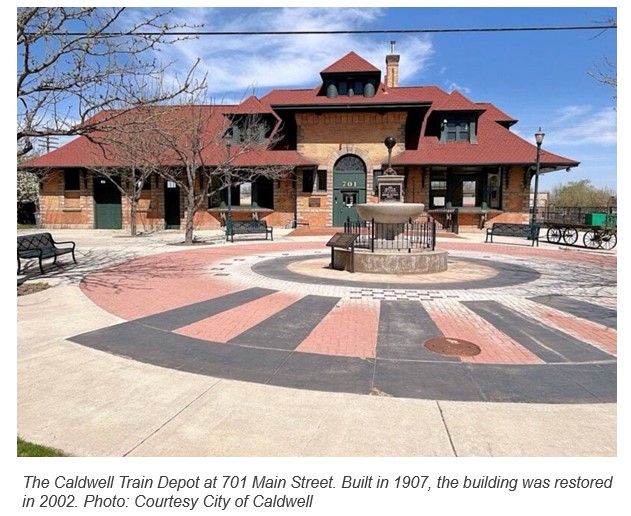
The current historic Caldwell Train Depot is actually the third depot on the site and was built in 1906. It is now owned by the City of Caldwell, which bought the building in 1989 for $1 on a 99-year lease. Today, the building serves as an events center