
Sawmill Fire Swamper Chainsaw Cut 2026 | Wildland Fire Lessons Learned Center

Description:
On June 19, 2026, a U.S. Forest Service wildland fire module was assigned to the Sawmill Fire near Cedar City, UT. The module was tasked with securing the fire’s edge and cleaning up ladder fuels to keep the fire out of the canopy. A saw team module, consisting of one sawyer and two swampers, moved steadily from tree to tree, limbing junipers while carefully managing each branch to keep it from dropping into the hot duff and subsequently dragging heat out into the “green” side of the fireline.

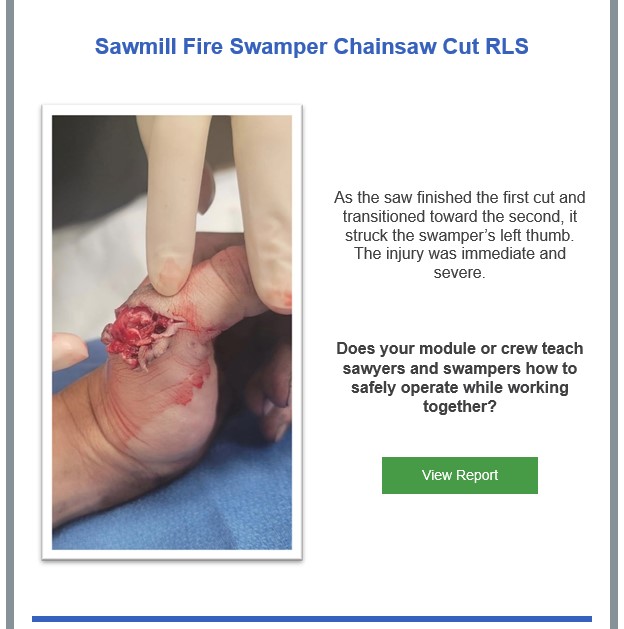
During one of these operations, the sawyer was cutting through a juniper limb, planning to continue directly into the next one. The swamper stood opposite, holding both limbs—one in each hand—to control their fall. As the saw finished the first cut and transitioned toward the second, it struck the swamper’s left thumb. The injury was immediate and severe.

The injury required eleven stitches for temporary closure. Future surgery will be required to repair tendons that were also severed. The expected recovery period is from six to eight weeks.

Sawmill Fire Swamper Chainsaw Cut RLS
Description:
On a clear spring morning in the mountains of northern California, a group of C-Evaluators and U.S. Forest Service Regional Saw Program Managers were gathered for the final day of a national saw workshop.

After sizing up the tree, the faller verbalized the elements of the OHLEC process (a standardized five-step safety and risk assessment framework for tree felling) to the two evaluators. His plan was to take the tree straight downslope (aligned with the primary head lean) into an open lay. He would utilize a double Humboldt face cut using a Stihl 500i chainsaw equipped with a 28-inch bar. The bole of the tree had a distinctly oval shape with the long axis oriented parallel to the slope.

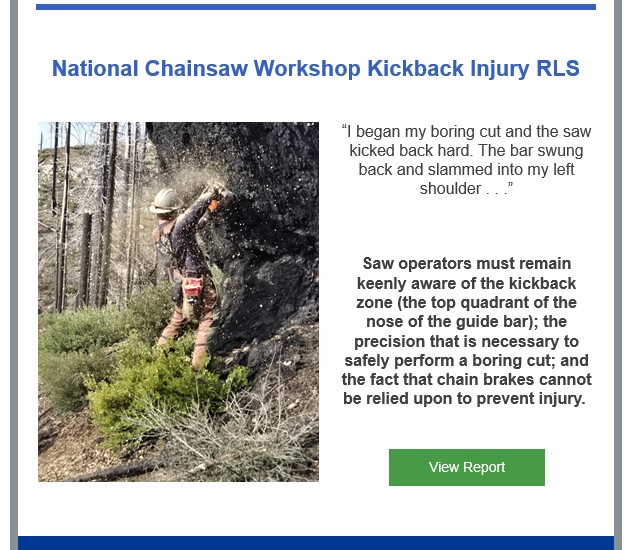
The faller fired up his saw and completed his initial cuts without issue. After knocking out the “pie”-shaped section and cleaning up the face cut, he elected to perform a boring cut straight through the hinge and into the center of the tree. His intent was to remove wood from the middle of the tree to ensure that he had adequate bar length to complete his planned double back cut from the uphill side.

First, the faller verbalizes his intent to “bore the guts” to the evaluators. He then steps downslope in front of the tree, lifts the powerhead and throttles up the saw. As he begins his boring cut, his right hand holds the throttle handle with a palm-down (pronated) grip. His left hand is located near the lower corner of the handlebar with a slightly supinated grip. The kickback occurs almost immediately.

The bar swung back and slammed into the sawyer’s right shoulder.

National Chainsaw Workshop Kickback Injury RLS
Good evening, Please see the following Lessons Learned Center release regarding two saw injuries that happened recently; one due to kick back and one occurring to a swamper. Please review these with your crews and modules to highlight the risks/hazards associated with some chainsaw operations along with some lessons shared by those involved in these events. Thanks and please reach out if you have any questions.
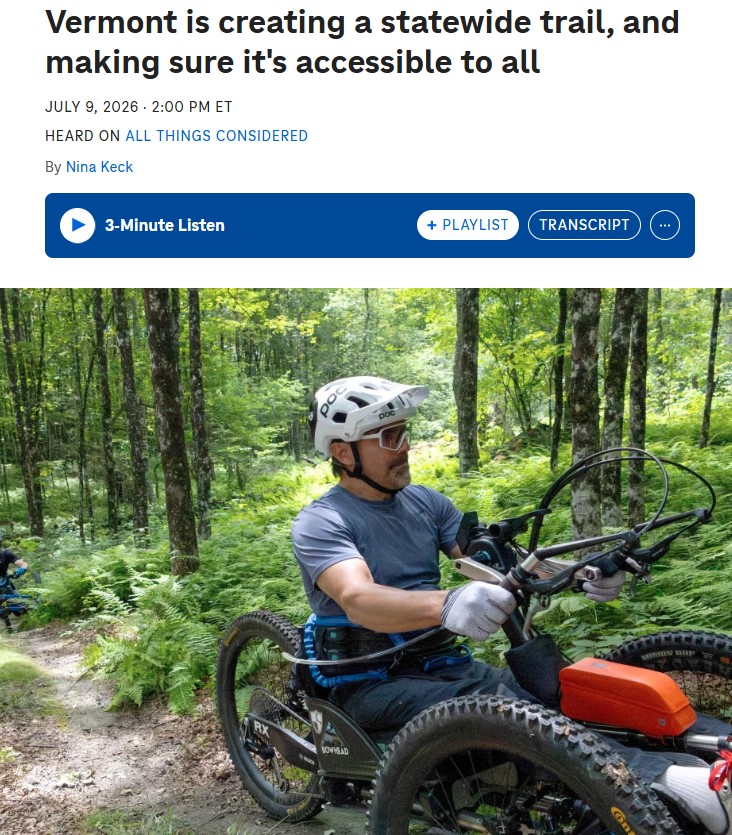
Mountain bike enthusiasts have been working for years on an ambitious 485-mile, multi-use trail called The Velomont that will span the length of the state.

When finished, the collaborative project will knit together existing trail networks, connect 27 communities and include huts and hostels for overnight stays.

New trail construction is finally ramping up after years spent on permits, plans and public input. And organizers say they want to make it as user-friendly as possible.

“For us, it’s not a huge lift to just be mindful when we’re trying to build trail or improve trail to think about the adaptive rider,” said Angus McCusker, the Velomont trail director with the nonprofit Vermont Huts and Trails.

“The challenge,” said McCusker, “is we’re connecting to existing trail networks that were never intended for adaptive bikes. So, where we can, we’re trying to do adaptive assessments.”

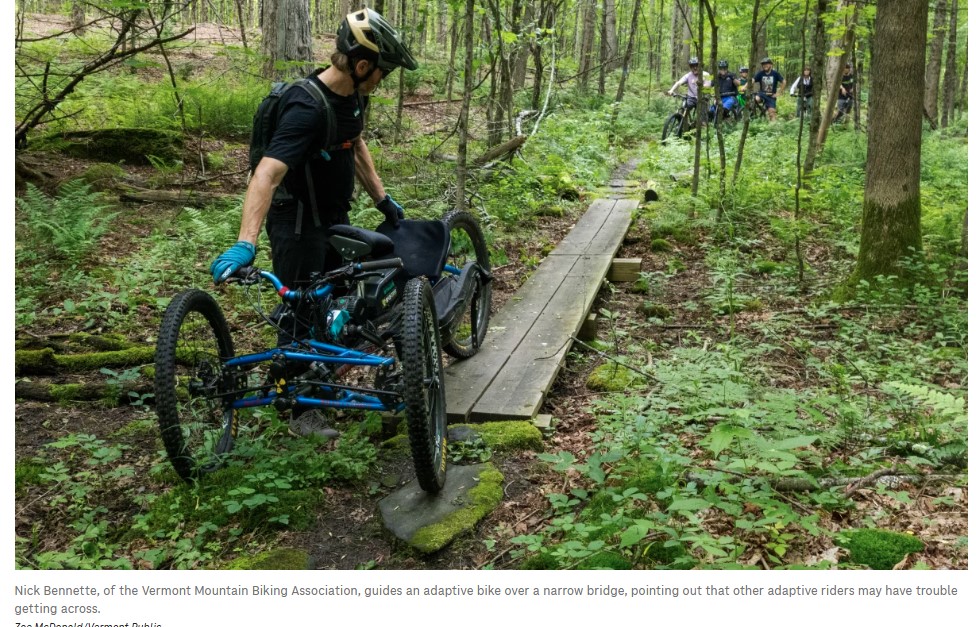
Louis Arevalo of Essex Junction is one of several adaptive athletes helping with that, most recently on some slightly overgrown single track trails in Randolph, a central Vermont town nestled along the eastern edge of the Green Mountains.

Arevalo pedals with his hands. He rides an electric powered recumbent-style three-wheeler that sits low to the ground. His service dog Azul chases along nearby.

“Once you realize what these bikes are capable (of) or this equipment actually opens up, it kind of blows your mind,” he said.

Arevalo was paralyzed in a skiing accident six years ago. Being able to get back on the trails has been a game changer, he said smiling.

“There’s a reason we live in the Green Mountain state. It’s because we like to get outside…you know, seeing the squirrels and chipmunks and birds… I mean, it’s life.”

But adaptive rigs like Arevalo’s are wider and heavier than regular mountain bikes, and not all trails are user-friendly.

“It’s helpful to have different kinds of adaptive bikes on these tests because they all handle a little differently,” he said.

Bennette is executive director of the Vermont Mountain Bike Association, another nonprofit spearheading efforts around the Velomont. He and others involved in the assessment are taking detailed photos and notes on ways to make the trails more accessible.

“Just scalloping out a bit of material on the outside of that corner,” said Bennette, pointing to the area the bike got caught. “That will allow adaptive bikes to make that corner without really changing the way the trail rides.”

But adaptive rigs like Arevalo’s are wider and heavier than regular mountain bikes, and not all trails are user-friendly.

“It’s helpful to have different kinds of adaptive bikes on these tests because they all handle a little differently,” he said.

Bennette is executive director of the Vermont Mountain Bike Association, another nonprofit spearheading efforts around the Velomont. He and others involved in the assessment are taking detailed photos and notes on ways to make the trails more accessible.

“Just scalloping out a bit of material on the outside of that corner,” said Bennette, pointing to the area the bike got caught. “That will allow adaptive bikes to make that corner without really changing the way the trail rides.”

Jeff Alexander is counting on it. He’s director of strategic partnerships with Vermont Adaptive Ski and Sports, a nonprofit that helps people with disabilities access outdoor recreation.

“So the adaptive community has money, they travel, they want to travel and they want to play with everybody,” Alexander said. “We just need to level the playing field so that everyone can play together.”