 Case Study: Heat Illness on an Early-Season Wildland Fire Assignment – NOLS
The Setting
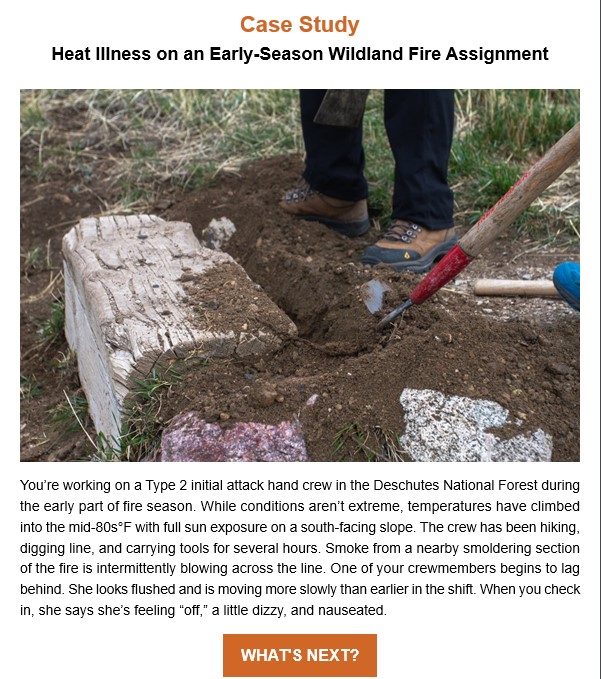
You are working on a Type 2 initial attack handcrew in the Deschutes National Forest during the early part of fire season. It’s one of the first assignments of the year, and while conditions aren’t extreme yet, temperatures have climbed into the mid-80s°F with full sun exposure on a south-facing slope.
The crew has been hiking, digging line, and carrying tools for several hours. Many members are new and this is the crew’s second week together. Smoke from a nearby smoldering section of the fire is intermittently blowing across the line.
Around mid-afternoon, one of your crewmembers, a 26-year-old female named Taylor, begins to lag behind. You notice she looks flushed and is moving more slowly than earlier in the shift. When you check in, she says she’s feeling “off,” a little dizzy, and nauseated. She also mentions her eyes are irritated from the smoke and that her contact lenses are bothering her.
You are the crew’s designated Wilderness First Responder (WFR). You decide to stop and perform an assessment.
 https://www.nols.edu/blog/case-study-embedded-tick-while-backpacking/
The setting
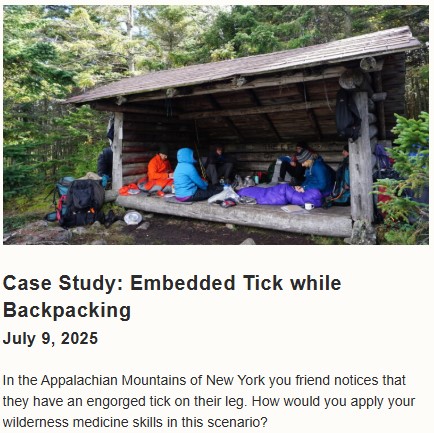
You’re on day 6 of a week-long backpacking trip on the Appalachian Trail in New York. The last few days have been beautiful, and you’re so glad to be enjoying this time outside. You and your friends decide it’s time for a break, so you sit down to enjoy some cool water and a snack. All of the sudden, one of your friends says, “Hey, I think there is a tick on me.” You wander over and offer to help out.