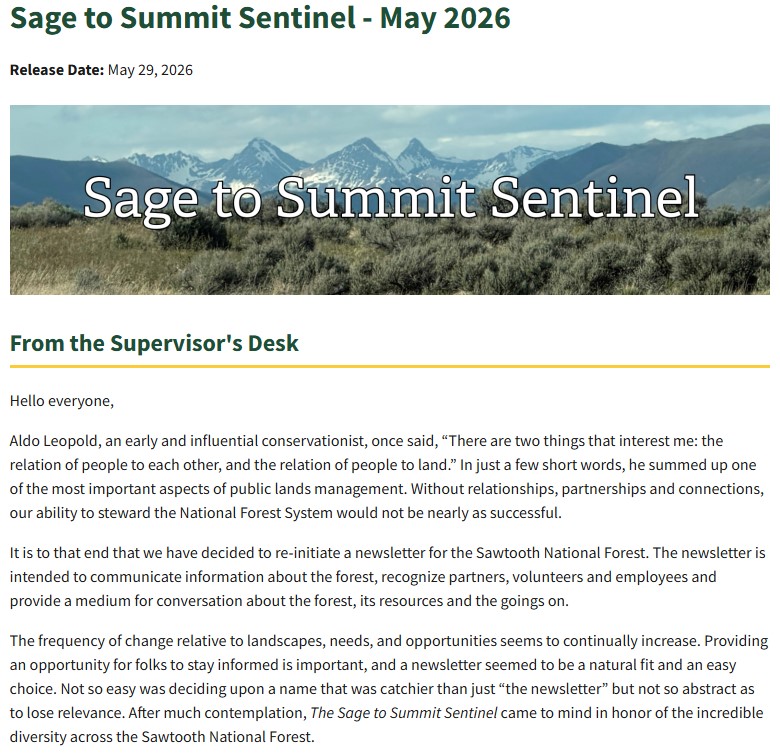
New Communication Tools in Play

The Sawtooth National Forest will be implementing a couple new communication tools to keep stakeholders informed about what’s happening on the Forest now and what’s on our horizon.

New Subscription Email Distribution System

We are so excited to be sharing this email through a new subscription email distribution system. Aside from being able to share what’s happening on the forest with stakeholders directly, the best part of this system is that stakeholders control whether or not they continue to receive these updates. Subscription and personal profiles can be managed in the footer of this email.

New users can subscribe for these updates themselves on our Keep in Touch webpage. We do want to warn those who choose to share these emails with others that each distributed email is tied directly to a specific email and profile. So, if you share the email with someone who doesn’t want to continue receiving updates, they may unintentionally unsubscribe you from our lists thinking they are doing it for themselves. To avoid this confusion, we will, as much as possible, put the bulk of the the content we want to share on our website so you can alternatively share the website addresses to the main content.

READ NEWSLETTER

Over the past few weeks, we’ve been bombarded with questions about SBFC’s position on the recent signing of the Minimum Requirements Analysis for chainsaw use on certain trails in the Frank Church- River of No Return Wilderness.

SBFC is a wilderness stewardship organization with “Frank Church” in our name, so people naturally want to know our stance and what “side” we are on. The us-vs.-them narrative on this subject, and so many others in our country, can be incredibly strong.

SBFC has never been about us vs. them. We are a non-advocacy, boots-on-the-ground stewardship organization. We recruit hundreds of volunteers and hire dozens of seasonal staff and interns each year to get an incredible amount of work done in the Selway-Bitterroot, Frank Church, and surrounding wildlands. One of our strengths is that we won’t play into the us-versus-them narrative. It’s not what we do.

But, for those wondering, what is SBFC’s position on this “in the news” topic? Here it is:  SBFC is a wilderness stewardship outfit. We do a ton of work on trails. We estimate that SBFC crews will maintain 600-1000 miles of trail under our current plans this season. It’s a tremendous amount of work.

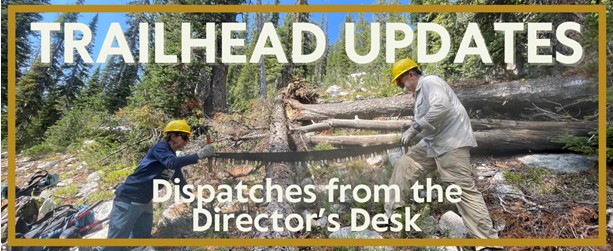
SBFC crews will use traditional tools while working in the wilderness this season, just as we have for the last twenty years. Our crews are experienced and skilled with crosscuts and axes, and they’ll remove 5,000-10,000+ logs from the trail corridor this season with those tools, skills, and passion.

SBFC wilderness trail crews do more than just remove logs. We forecast that our crews will likely spend 30-40% of their time cutting logs this season. Tread repair and drainage work has become an increasingly large part of what our crews do. This work is not optional; it truly sustains the resource. Brushing (no one’s favorite job) is equally important for the long-term sustainability of the trail. You can be sure we’ll be doing a whole lot of this work, in addition to cutting out thousands of logs.

All of this is to say, SBFC is laser-focused on wilderness stewardship. For us, wilderness stewardship means we’ll be using traditional non-motorized / non-mechanized tools when working in the wilderness, whether removing logs from the 8 ft wide trail corridor, removing brush, kicking rocks off the tread, or repairing the tread itself, which is a highly technical, skilled task where there are no shortcuts to doing good work.

No matter the tool or task, it takes an incredible amount of human time, effort, and skill to accomplish wilderness and trail stewardship goals across this landscape. It takes more humans than we have had out there in recent years (or decades). So, we will focus on bringing more humans into the fold and out on the ground. In 2026, we have our largest ever cohort of seasonal staff and interns (34!), and not by a small margin. We’ll engage with the most adult and youth volunteers in our history, and again, not by a small margin. We can see the energy, the excitement, and the momentum. It is real. Those are the things that we need, and those are the things that stand the test of time as we look ahead, not just for the next few years, but for decades to come.

SBFC exists because people love wilderness, and people care about these places a whole lot. We can say with confidence that many people will continue to love and care about these places far into the future.

Our mission is to open pathways for all to discover and steward wilderness. Stewarding wilderness is hard. It’s especially hard in the largest wilderness in the lower 48. What a privilege it is to play our role in this endeavor and to do it well. You can find us out there this season, from Missoula to Boise, and all points between, working to keep the wildest place accessible.

As always, feel free to reach out with thoughts, questions, or comments!

Wilderness Forever & For Everyone,

As a side and stomach sleeper, I despise mummy-style sleeping bags. I always feel too confined, and, in the morning, my hip flexors are tight and sore. For a long time, I thought that was my cross to bear as a backpacker who wanted a lightweight bag, until I found NEMO’s Disco 15 Sleeping Bag ($300).
The Disco 15 has a more generous, roomy fit than a typical mummy bag, with what NEMO calls a “spoon shape.” There’s extra space for my elbows and knees, allowing me to roll around and splay out in comfort.
While it’s not ultralight at 3 pounds, 5 ounces, the bag is certainly light enough to bring on a week-long backpacking trip.
Perhaps most importantly for camping/backpacking gear, this bag is durable. I’ve had it for 5 years, and it’s seen everything: mud, sweat, and my dogs (and their vomit). When I snuggle up in the Disco 15 to go to bed, I’m just as warm and cozy as I was on night 1.
Product score: 7.9/10

READ MORE

https://www.aspenpublicradio.org/2026-05-14/forest-service-oks-chainsaws-to-clear-trails-in-one-of-the-largest-wilderness-areas

The U.S. Forest Service has granted a rare exemption allowing the use of chainsaws in one of the country’s largest wilderness areas.

The agency on Wednesday approved a request from the Idaho Outfitters and Guides Association to temporarily use gas-powered chainsaws to clear about 542 miles of trails in the Frank Church-River of No Return Wilderness, citing “extraordinary levels” of downed trees. The Frank Church, in central Idaho, is the largest contiguous wilderness area in the lower 48 states.

“This action is necessary to restore safe public access while minimizing impacts to wilderness character and remaining fully compliant with the Wilderness Act of 1964,” Amy Baumer, a spokesperson for the Salmon-Challis National Forest, wrote in an email.

Trees blocking trails

Trail crews typically rely on hand tools such as crosscut saws in designated wilderness areas, which are among the most protected public lands. The Wilderness Act prohibits motorized vehicles and equipment to protect places “untrammeled by man” and to preserve “solitude.”

These exclusions have long been interpreted to include chainsaws, though the Forest Service grants occasional exceptions, usually after wildfires or major storms.

But the Idaho Outfitters and Guides Association (IOGA) petitioned the agency last year, arguing that decades of wildfire and disease have created an unmanageable buildup of fallen trees. A Forest Service survey last year estimated between 80,000 and 110,000 trees lying along one 150-mile stretch in the Frank Church.

“Almost half the trails in this wilderness area on the Salmon-Challis are unusable,” said Erik Weiseth, the executive director of IOGA. “Over time, they will just be overgrown and disappear. That is not only hurting our outfitter members, but it’s also hurting the general public. It’s hurting their ability to access the wilderness.”

Weiseth said the blockages have meant lost business for outfitters who can’t get to the spots where they’re authorized to run hunting or guided horseback trips. Volunteers and a shrinking Forest Service workforce have struggled to keep trails open with hand tools, he said. He also pointed to language in the law specific to the Frank Church wilderness, which directs the agency to clear trails annually “to the maximum extent practicable.”

What’s allowed in wilderness?

In a letter on Wednesday, the nonprofit Wilderness Watch asked the Forest Service to delay implementation until 2027 to allow time for judicial review “before the wilderness is overrun with chainsaws.”

George Nickas, the executive director of the Missoula-based organization, called the authorization “just blatantly illegal” and said the organization is considering legal action.

“Getting in there with chainsaws to clear all these trails – it’s all about domination. It’s all about our controlling what’s going on there, our wanting to change the character of the wilderness to meet our demands,” he said. “That’s just the antithesis of what the Wilderness Act is all about.”

The group said it learned of discussions between IOGA and Forest Service officials, including Chief Tom Schultz who is from Idaho, through public records requests. It criticized the agency for not allowing public comment before the approval.

Nickas said the decision could have implications beyond Idaho. Public records reviewed by the group indicated outfitters in Wyoming asked the agency to allow battery-operated chainsaws for trail maintenance.

In 2019, the Forest Service approved chainsaw use in two wilderness areas in Colorado. Conservation groups including Wilderness Watch sued, and the agency later withdrew the proposal.

Two people use a crosscut saw to cut a fallen tree in the forest.
U.S. Forest Service
A trail crews uses a crosscut saw to cut a fallen tree in the Gila National Forest in New Mexico.

The authorization by the Forest Service in the Frank Church allows licensed outfitters to use chainsaws for three years from Jan. 1 through Aug. 1 each year.

Weiseth said that by Wednesday afternoon, authorized outfitters were already in the forest clearing logs.

“This is a big deal to these guys. They’ve been wanting to get some of these trails open for a decade or more,” he said. “They threw their stuff in the truck and started driving to the woods, ready to go.”

This story was produced by the Mountain West News Bureau, a collaboration between Wyoming Public Media, Nevada Public Radio, Boise State Public Radio in Idaho, KUNR in Nevada, KUNC in Northern Colorado, KANW in New Mexico, Colorado Public Radio, KJZZ in Arizona and NPR, with additional support from affiliate newsrooms across the region. Funding for the Mountain West News Bureau is provided in part by the Corporation for Public Broadcasting and Eric and Wendy Schmidt.

For Immediate Release: Tuesday, May 12, 2026

Contacts:

John Robison, Idaho Conservation League, (208) 345-6933 x 213

Nick Kunath, Idaho Rivers United, (208) 908-9232

Fred Coriell, Save the South Fork Salmon, (208) 315-3630

Jared Naimark, Earthworks, (650) 213-8052

Marc Fink, Senior Attorney, Center for Biological Diversity, (218) 464-0539 

Coalition of Conservation Groups Asks Court to Halt Construction of Stibnite Gold Mine

Boise, ID — A coalition of local and national conservation groups filed a motion preliminary injunction last Friday to halt Perpetua Resource’s pending construction of the Stibnite Gold Project: an open-pit cyanide leach gold mine in the headwaters of the South Fork of the Salmon River. The motion asks to halt construction of the mine on public lands, including constructing a new access road cutting through Idaho’s Salmon River Mountains, in order to protect the environment and “threatened” species.

In February 2025, the conservation groups filed suit in federal district court against the U. S. Forest Service for violating the National Environmental Protection Act and other bedrock environmental laws in approving the mine, which would be located mostly on National Forest lands. The lawsuit is also against the U.S. Fish and Wildlife Service for violating the Endangered Species Act by failing to protect threatened bull trout, wolverine, and whitebark pine. The Forest Service’s own analysis shows that the project area would not be restored as Perpetua claims but would actually be worse off if the project proceeds—even if the proposed restoration work goes perfectly according to plan.

Last fall, the conservation groups and Perpetua reached an agreement allowing limited pre-construction activities to occur while the lawsuit was being briefed. Briefing concluded earlier this year (see “Case Filings” here). Perpetua now seeks to commence “full construction” at the end of May, without waiting for a final decision from the Court.

Among other initial mine construction activities, Perpetua has indicated it will start constructing the Burntlog Route: a second and new access road to the mine site, through protected roadless and riparian areas and threatened species habitat. Perpetua would reconstruct and widen 23 miles of existing road on National Forest to be approximately four times wider than standard roads in the area to accommodate industrial mine traffic. To complete the Route, Perpetua would also build 15 miles of new road through remote wildlife habitat, mostly in inventoried roadless areas.

“The South Fork Salmon River and everything and everyone who depends on it are at risk if the government allows our public lands to be monetized to benefit billionaires,” said John Robison, Public Lands and Wildlife Director for the Idaho Conservation League. “We believe the South Fork Salmon River deserves its day in court before Perpetua Resources and its financiers rush ahead and make irreversible changes to this special area.”

The Stibnite site is 45 air miles from McCall, Idaho, adjacent to the Frank Church–River of No Return Wilderness Area and is within the homelands of the Nez Perce Tribe. Perpetua’s massive mine plan entails excavating three open pits. It would create 280 million tons of waste rock and include constructing a 475-foot tall, 120-million-ton tailings storage facility—more than 1.5 times taller than the Statue of Liberty. One of the open pits would extend more than 720 feet beneath the riverbed of the East Fork South Fork Salmon River. Perpetua would also build an extensive web of roads, power lines, and other industrial infrastructure across public lands to reach the remote mine site.

“We’re seeking to prevent this special part of Idaho from being irreversibly damaged before the legal process has run its course,” said Bryan Hurlbutt, staff attorney at Advocates for the West and counsel for the conservation groups. “Our preliminary injunction motion asks the Court to preserve the status quo until it issues a final ruling in the lawsuit.”

“Rushing to construct the mine is just one more instance of Perpetua putting its profits first, instead of being the ‘good neighbor’ the company pitches to the community,” said Judy Anderson of Save the South Fork Salmon.

“In light of Perpetua’s push to begin full construction, court intervention is necessary to protect critical habitat in the South Fork Salmon watershed from damages that simply cannot be undone,” said Nick Kunath, Conservation Director at Idaho Rivers United. “This watershed and all that it provides deserves much more than allowing Perpetua to plow forward with damaging activities before the case before the court has had a chance to be resolved.”

“The rush to make a profit is not more important than the law,” said Jared Naimark, Western Mining Senior Manager at Earthworks. “Legal protections exist to ensure the South Fork of the Salmon River, our National Forests, and the animals that call these lands and waters home are taken care of for generations to come. The proposed Burntlog route is an unlawfully approved second access road. It would damage protected roadless areas and streams and harm endangered wolverine and bull trout. Perpetua Resources must not construct the road before the courts have decided whether the project is allowable. That damage can’t be undone once it happens.”

###

Save the South Fork Salmon strives to protect and preserve the ecological, cultural, and economic resources of the South Fork of the Salmon River watershed and the well-being of the people that depend on them for generations to come.

www.savethesouthforksalmon.com

Idaho Conservation League’s mission is to create a conservation community and pragmatic, enduring solutions that protect and restore the air you breathe, the water you drink, and the land and wildlife you love.

www.idahoconservation.org

Advocates for the West is a non-profit, public interest environmental law firm headquartered in Boise, Idaho, that works to defend public lands, water, fish and wildlife throughout the American West.

www.advocateswest.org

Idaho Rivers United’s mission is to protect and restore the rivers and fisheries of Idaho, and is the only conservation organization in the state focused exclusively on the health and protection of river resources.

www.idahorivers.org

Earthworks mission is to protect communities and the environment against the adverse impacts of mineral and energy development while seeking sustainable solutions.

www.earthworks.org

The Center for Biological Diversity is a national, nonprofit conservation organization with more than 1.7 million members and online activists dedicated to the protection of endangered species and wild places.

www.biologicaldiversity.org

American Rivers is championing a national effort to protect and restore all rivers, from remote mountain streams to urban waterways.

www.americanrivers.org

By now, you’ve likely seen local, regional, western, and national coverage of the Trump administration’s plan to reorganize the Forest Service.

The proposal includes moving the agency’s headquarters from Washington, D.C. to Salt Lake City, eliminating the 9 Regional Offices, establishing 15 new State Offices (including one in Boise), setting up a network of Service Centers, and consolidating 77 Research Centers into as few as 20.

Hundreds of conservation groups and outdoor companies are sounding the alarm, warning that the Forest Service is essentially being dismantled. In response, the Forest Service itself took the unusual step of releasing a “Myth vs. Facts” statement in an attempt to push back on that narrative.

Several retired Forest Service supervisors describe the proposal not as a dismantling but as a “flattening” of what they see as a top and middle management-heavy (muffin-topped) organizational structure. In their view, the changes could ultimately be beneficial—reducing costs, improving efficiency, and helping staff get more work done. The Forest Service Chief also noted that no changes would be made until after this year’s wildfire season.

Still, the massive pushback against the reorganization (“Blink twice if you are being kidnapped, Smokey”) reflects a far deeper concern: many people who value public lands see this as part of a broader pattern—one that could ultimately lead to weakening protections and selling off public lands.

liminating Regional offices and creating State offices

Currently, North Idaho forests are managed out of the Region 1 office in Missoula, Montana, while south Idaho forests are managed out of the Region 4 office in Ogden, Utah. Replacing regional offices with state offices could make sense—if done thoughtfully. The Bureau of Land Management (BLM) already uses a state-based structure with reasonable success, but that model depends on adequate staffing and resources.

However, as currently envisioned, the Forest Service State Offices would be staffed by only a handful of employees and would lack the full complement of Regional staff who have special expertise in mine engineering, forest pathogens, cultural resources, and Treaty Rights, and more. While the newly proposed Service Centers could house some of these experts, that is not stated in the current plan. The result could be further loss of institutional knowledge when we can least afford it.

The importance of a Washington presence

While maintaining local District Ranger and Forest Supervisor offices makes sense for working with local communities, the Forest Service leadership also needs to engage directly with members of Congress and other federal agencies in critical matters like budgeting and coordination. Key decisions are made in D.C, not Salt Lake City. A reduced presence there could leave the Forest Service at a distinct disadvantage. As the saying goes, “If you’re not at the table, you’re on the menu.” A diminished Washington office might lead to reduced funding, staffing, and ability to keep the Forest Service intact.

Institutional knowledge

One of the biggest risks is the loss of staff with critical institutional knowledge. When the last Trump administration moved the BLM’s headquarters from Washington, D.C. to Grand Junction, Colorado, hundreds of employees retired or left their jobs rather than relocating. These people never came back. The move didn’t result in savings but instead a significant loss of expertise.

We have the same concerns here. To make matters worse, the Forest Service is already dealing with staffing gaps following last year’s senseless, chaotic and illegal DOGE-related cuts. While some staff were hired back, many were not. This reorganization could exacerbate those losses. Furthermore, Congress is not being consulted about this reorganization.

Research at risk

Forest Service research stations collect critical data on watersheds, fisheries, wildlife, forest health, and silviculture, among many other topics. Consolidating or closing these stations raises serious concerns (“It’s just madness”)—especially if long-term study sites and datasets are abandoned in the process. These Stations are essential in generating applied research which is essential for preparing for disasters and guiding restoration. Weakening them now is a step in the wrong direction.

The Ugly

While ICL has questions about the real intent behind the reorganization, the more troubling issues arise over changes in priorities, policy, and by extension, land management—particularly around public review of proposed projects.

The Forest Service argues that this reorganization will move decision-makers closer to the public so the agency can better serve them. However, at the same time, recent changes to NEPA regulations reduce or remove opportunities for the public to learn about and provide input on Forest Service activities. So while decision makers may be geographically closer to you, they are now no longer allowed to host public comment periods for the majority of the projects affecting Idahoans.

This reality is already playing out. Take the Upper Bigwood Vegetation Management Project near Galena in the Sawtooth National Recreation Area for example. This 2,500-acre proposed project—in a landscape that is highly visible, well used, and well loved—would typically be analyzed through an Environmental Assessment (EA) with scoping and comment periods. These public comments provide community members with meaningful opportunities to shape the project,helping to optimize treatment activities and minimize negative impacts. In the past, the Forest Service has made substantive project improvements as a result of public comments. However, under the new regulations and the new Emergency Authorization, this project is proceeding without an official public comment period (there is an open house on May 11). That represents a significant shift away from public participation.

The Forest Service isn’t dead…at least not yet. The Ranger Districts, Forests and Forest Supervisor offices are all still here. The agency even hired seasonal staff for trail work. And citizen-led forest restoration collaboratives like the Boise Forest Coalition continue to connect communities to the Forest Service. But the reform the agency truly needs isn’t the proposed “structural overhaul”—or preparation for disintegration—but a restoration of the funding and adequate staffing to fulfill its mission: “Caring for the Land and Serving the People.”

Breathing Issues

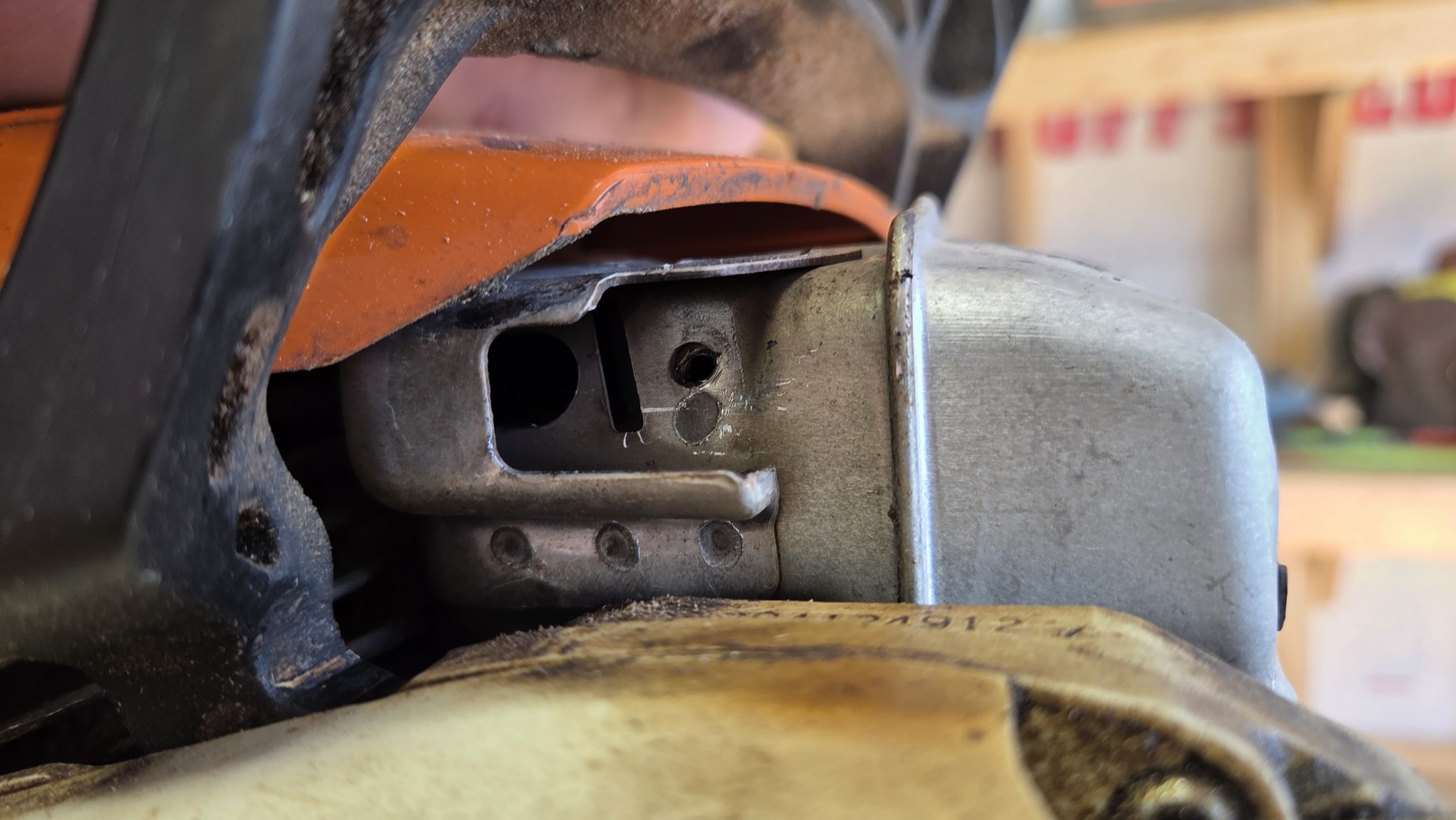
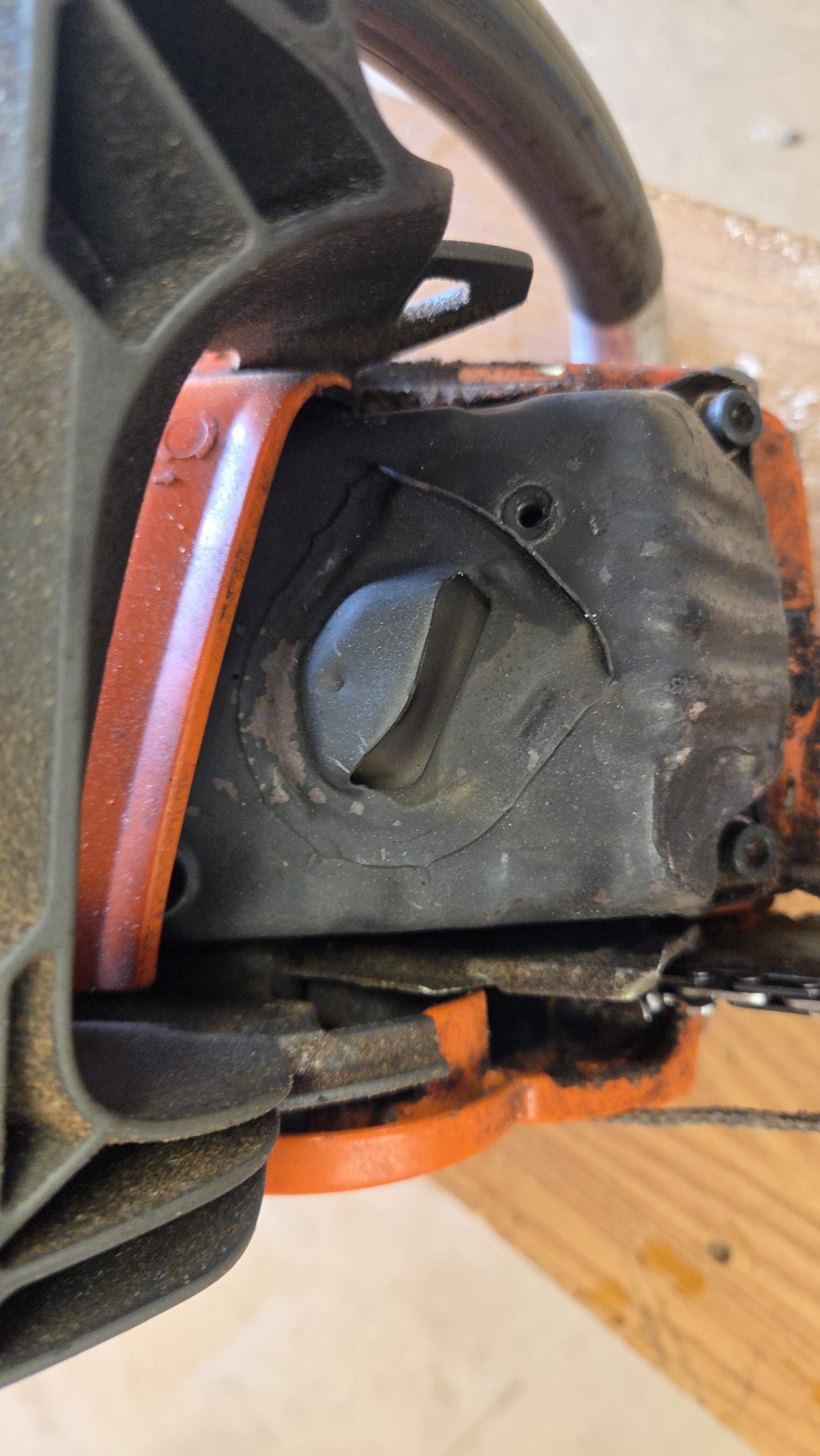
If your chainsaw is losing power, bogging down, or struggling to rev, the issue might be simpler than you think.

A common but overlooked culprit is a clogged exhaust.

Over time, carbon buildup can restrict airflow through the muffler or spark arrestor screen. When exhaust gases can’t escape, your engine can’t breathe—and performance suffers.

What causes it?

Running rich fuel mixtures, low-quality oil, or long periods of idling can all lead to carbon buildup.

How do you know?

Look for these signs:
• Loss of power under throttle
• Bogging or poor acceleration
• Excessive smoke

To fix it, remove the muffler cover and check the spark arrestor screen. If it’s coated in carbon, clean it by:
• Brushing off buildup
• Burning it off safely
• Replacing it if needed

Also, inspect the muffler outlet for deposits and clean as necessary.

Also, inspect the muffler outlet for deposits and clean as necessary.

Restoring airflow can quickly bring back lost performance. Before jumping into major repairs, check the basics first.

If you need replacement parts, we’ve got you covered.

Stay safe, and keep cutting smart. Sawzilla Parts <info@sawzillaparts.com>

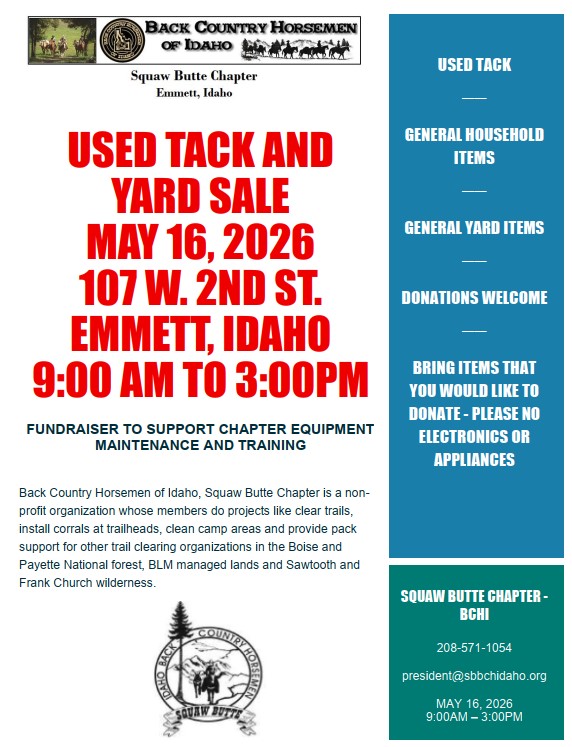
Yard Sale Flyer 2026