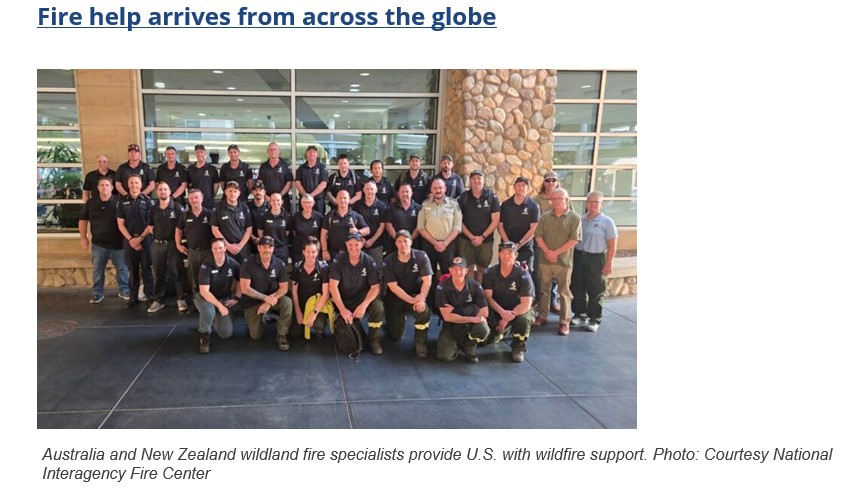
A second wave of international help has arrived in Idaho to help fight fires in the Northwest and Great Basin, after the National Multi-Agency Coordinating Group, located in Boise, asked for help.
Nearly 200 firefighters from Australia and New Zealand landed at the National Interagency Fire Center (NIFC) in Boise last week and have since undergone several days of orientation, training, and national situation briefings.
Previously, 74 fire management specialists, including a 15-person incident management team, from New Zealand and Australia arrived in Boise and have been working with U.S. personnel to “support command and control, planning, logistics, operations, and safety oversight.”
In a news release, NIFC said, “Their deployment will enhance staffing depth during a period of sustained wildfire activity and will help ensure safe, effective, and well-coordinated operations. All international specialists are fully qualified based on U.S. wildland fire standards and will be fully embedded within U.S. incident command structures throughout their assignments.”
NIFC said the specialists from down under bring “diverse expertise, including aviation operations, fireline leadership, prevention and mitigation strategies, and emergency communications support.”
According to the U.S. Department of Agriculture (USDA), the U.S. Forest Service has had a working relationship with Australia and New Zealand through the Forest Fire Management Group since the 1950s, but picked up steam in the 2000s.
Currently, one of the largest fires burning in the country is the Big Grass Fire in Eastern Oregon and into Southwestern Idaho. It has burned more than 579,000 acres and is currently 85% contained. It was started by lightning on July 23.
In an online briefing Wednesday, NIFC said the “Northwest remains the nation’s most active fire area, with 34 uncontained large fires. High temperatures and wind are predicted in several geographic areas, bringing the potential for new starts and/or rapid spread.” As of July 18, the NIFC has put the country at National Preparedness Level 5, the highest level based on “fire activity, weather, fuel conditions, and resource availability.”