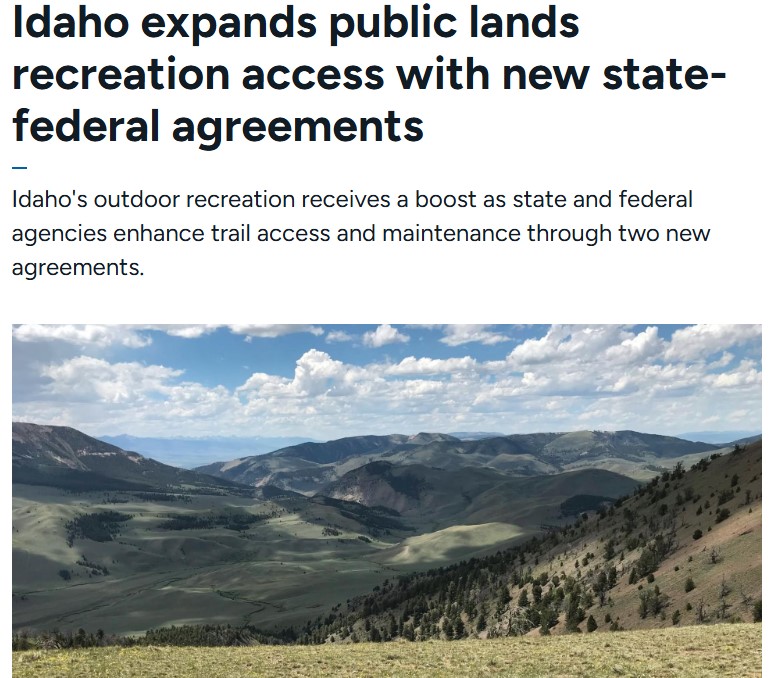
BOISE, Idaho — Outdoor recreation in Idaho is set for an improvement, according to an expanded partnership between state and federal agencies.

The Idaho Department of Parks and Recreation and the U.S. Forest Service announced that they are expanding their partnership through two Good Neighbor Authority recreation agreements that will “improve trails, restore access to public lands and enhance outdoor recreation opportunities across Idaho.”

The first recreation agreement covers the Idaho Panhandle and Nez Perce-Clearwater National Forests, utilizing the EXPLORE Act’s Good Neighbor Authority recreation pilot.

This first-of-its-kind agreement will provide “approximately $166,000 for recreation improvements, including maintenance of 115 miles of non-motorized trails and new or upgraded signage across 1,200 miles of winter recreation trails throughout North Idaho.”

The second agreement includes the Salmon-Challis National Forest and intends to improve recreation access for Idahoans within the Frank Church Wilderness and its surrounding areas.

According to this agreement, “IDPR will assist with clearing downed trees and other obstacles from portions of 542 miles of trail impacted by wildfire, insects, and disease, while also supporting construction of a motorized trail that restores public access to a significant area of Idaho’s backcountry.”

“These agreements represent the future of public land stewardship in Idaho,” said Idaho Department of Parks and Recreation Director Susan Buxton in a news release. “By partnering with the U.S. Forest Service through the Good Neighbor Authority, we’re protecting some of Idaho’s most treasured landscapes while making them more accessible for residents and visitors alike. Together, we’re ensuring our trails and recreation opportunities remain safe, sustainable and enjoyable for generations to come.”

Both agreements build upon the EXPLORE Act of 2025, which paved the way for state and federal agencies to work together on recreation projects that improve public access and stewardship of National Forest lands.

“The Nez Perce-Clearwater National Forests and Idaho Department of Parks and Recreation have a long-standing history of working together to improve and maintain recreational access and opportunities,” said Forest Supervisor for the Nez Perce-Clearwater National Forests Jon Word. “Expanding this partnership through Good Neighbor Authority leverages our shared resources across boundaries, benefiting the public and the places we love to recreate.”

For those who enjoy the great outdoors, it seems this latest collaborative effort will expand and preserve opportunities in the wild for Idahoans to partake in.


LINK TO PAGE

Link to PDF

READ MORE

READ MORE

LINK TO THIS PODCAST

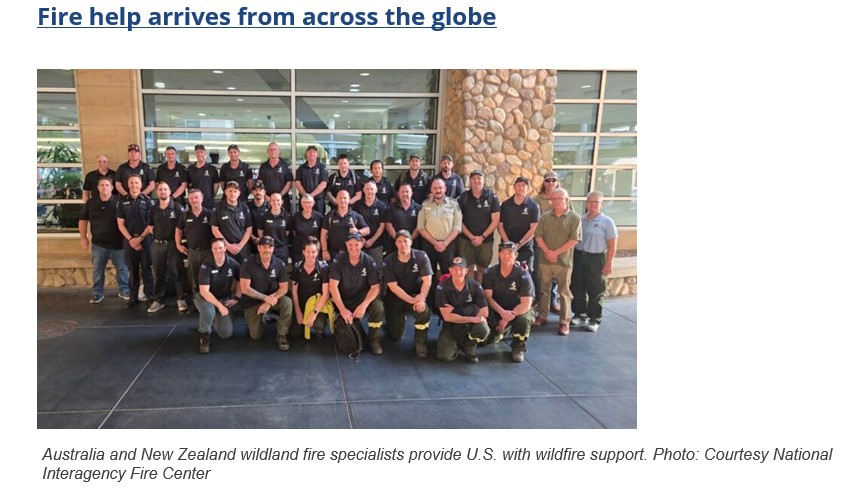
A second wave of international help has arrived in Idaho to help fight fires in the Northwest and Great Basin, after the National Multi-Agency Coordinating Group, located in Boise, asked for help.

Nearly 200 firefighters from Australia and New Zealand landed at the National Interagency Fire Center (NIFC) in Boise last week and have since undergone several days of orientation, training, and national situation briefings.

Previously, 74 fire management specialists, including a 15-person incident management team, from New Zealand and Australia arrived in Boise and have been working with U.S. personnel to “support command and control, planning, logistics, operations, and safety oversight.”

In a news release, NIFC said, “Their deployment will enhance staffing depth during a period of sustained wildfire activity and will help ensure safe, effective, and well-coordinated operations. All international specialists are fully qualified based on U.S. wildland fire standards and will be fully embedded within U.S. incident command structures throughout their assignments.”

NIFC said the specialists from down under bring “diverse expertise, including aviation operations, fireline leadership, prevention and mitigation strategies, and emergency communications support.”

According to the U.S. Department of Agriculture (USDA), the U.S. Forest Service has had a working relationship with Australia and New Zealand through the Forest Fire Management Group since the 1950s, but picked up steam in the 2000s.

Currently, one of the largest fires burning in the country is the Big Grass Fire in Eastern Oregon and into Southwestern Idaho. It has burned more than 579,000 acres and is currently 85% contained. It was started by lightning on July 23.

In an online briefing Wednesday, NIFC said the “Northwest remains the nation’s most active fire area, with 34 uncontained large fires. High temperatures and wind are predicted in several geographic areas, bringing the potential for new starts and/or rapid spread.”  As of July 18, the NIFC has put the country at National Preparedness Level 5, the highest level based on “fire activity, weather, fuel conditions, and resource availability.”

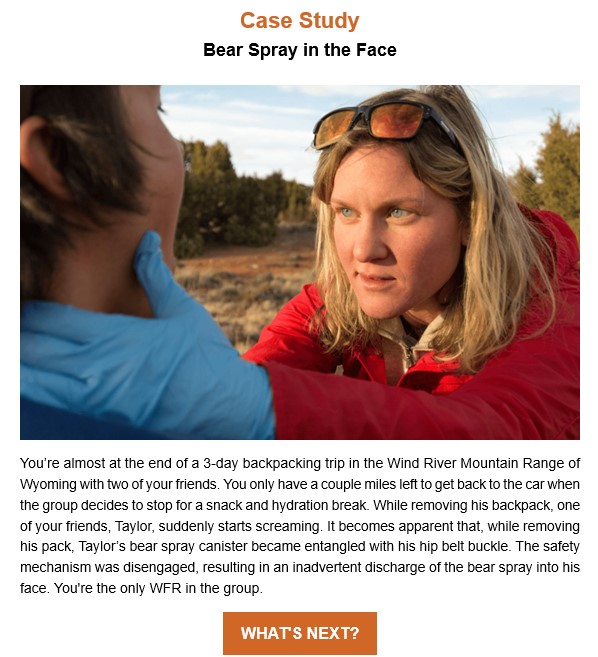
Case Study – Bear Spray in the Face

Earlier this summer, I was jogging on a local trail with my 7-year-old black lab mutt, Camas, when she suddenly froze. The fur along her spine bristled. Then she let out a single, sharp bark — a timbre I’d never before heard.

I caught the unmistakable musk of an animal and my hand shot to the bear spray on my chest. Halfway up a tree less than 20 yards away, a beautiful, small cinnamon black bear stared back at us.

The bear scampered off as Camas growled, standing her ground in front of me on the trail. “Good girl,” I told her, my heart rate slowing to a normal pace. My dog, I assumed, warned me early of a potential threat. I was proud.
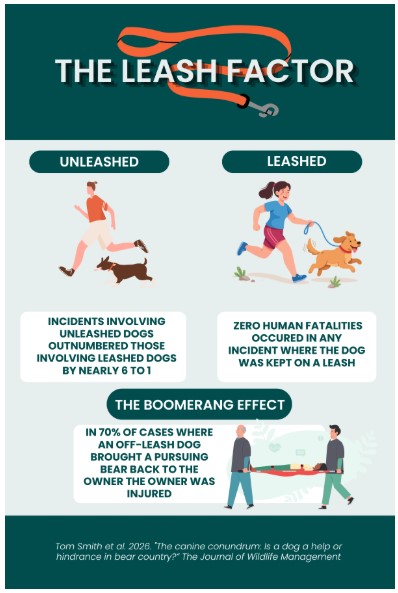
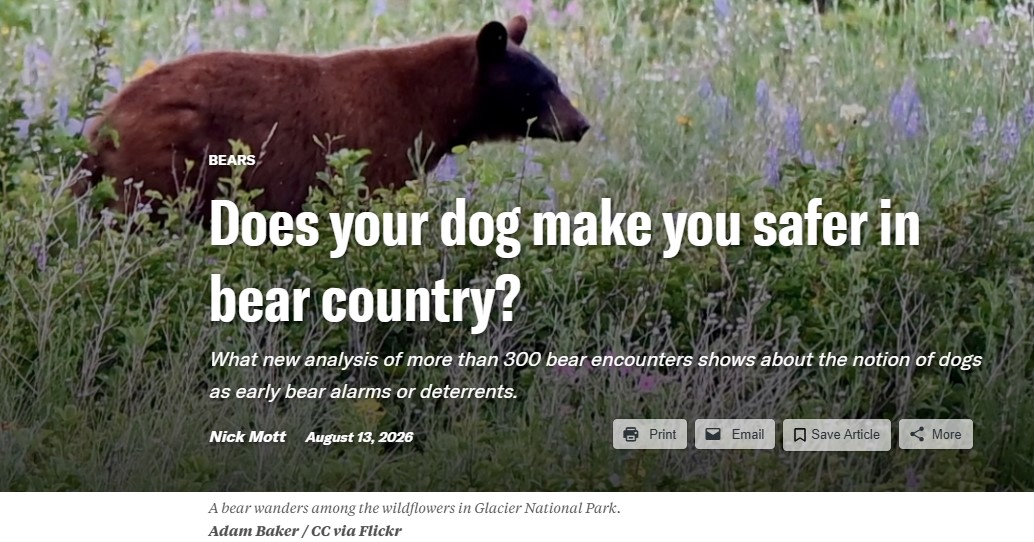
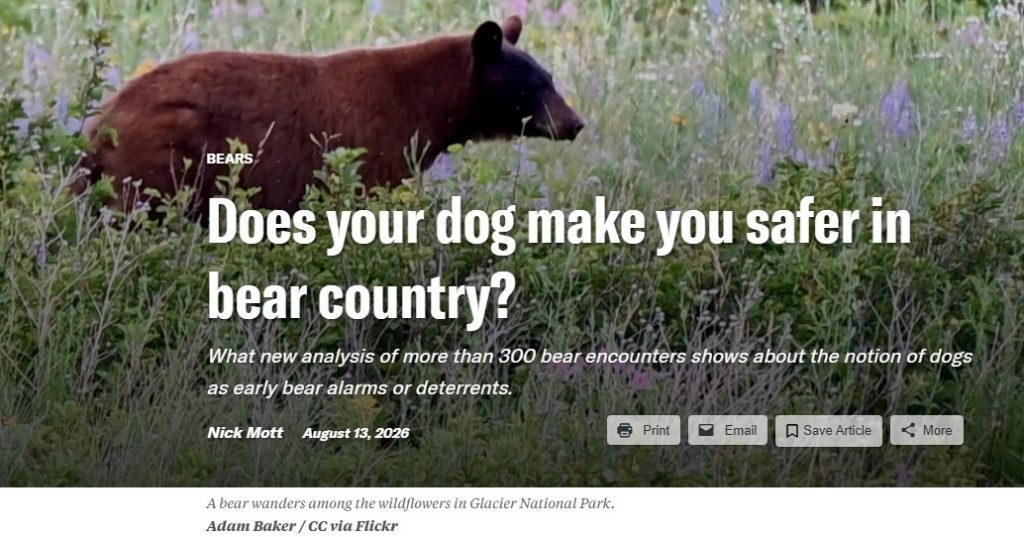
In bear country, common wisdom holds that dogs serve as early bear alarms, or even deterrents. That belief, however, has long rested mostly on anecdote. Until recently, almost no one had tested whether it was actually true.

A new study in the Journal of Wildlife Management analyzed bear-dog conflicts involving black, polar and brown bears from Alaska to Florida. The results challenge the idea that dogs make people safer in bear country and they have me rethinking my relationship with Camas in the woods.

“If you think a house pet is likely going to be your bear, not only detector but deterrent, you might want to think twice about that,” lead author of the paper Tom Smith told me over Zoom, one of his dogs begging for attention in the background while mine snoozed next to me.

Smith, a research wildlife biologist at Brigham Young University in Utah, analyzed 326 bear-dog encounters spanning more than a century, drawing from newspaper articles, federal and state government reports, books, records compiled by other bear specialists, and internet searches.

Smith began working with bears more than 30 years ago in Alaska’s Katmai National Park. He’s published influential research on bear spray and guns as bear deterrents, and has become one of the world’s leading experts on human-bear interaction. “As soon as you become the bear guy, then everybody comes running to you for advice on how to be safe,” he said. “So I thought, ‘I’m going to have to get to the heart of this.”

Smith has long been interested in the way dogs impact humans’ odds of an encounter in bear country. But the issue became urgent and tangible to him following a 2023 attack that left two people and their dog dead in a tent in Canada’s Banff National Park. The issue hasn’t gone away. This summer alone, a jogger and his dog were mauled near Island Park, Idaho, while recordings of separate encounters involving dogs in Banff and Alberta went viral online.

The findings

The data show people are largely unprepared for bear encounters and naive to their possible consequences. Dogs ran away, fought with bears, provoked confrontations, drew owners in to fight off bears barehanded, and even boomeranged bears back to people.

The first surprise in the data was how few people carried any deterrent at all. That might be because people thought, erroneously, Smith says, that dogs would be sufficient to keep bears away. Recreators wielded bear spray in only about a tenth of cases and a firearm in roughly a third. All told, five people and 56 dogs died in the encounters Smith analyzed.

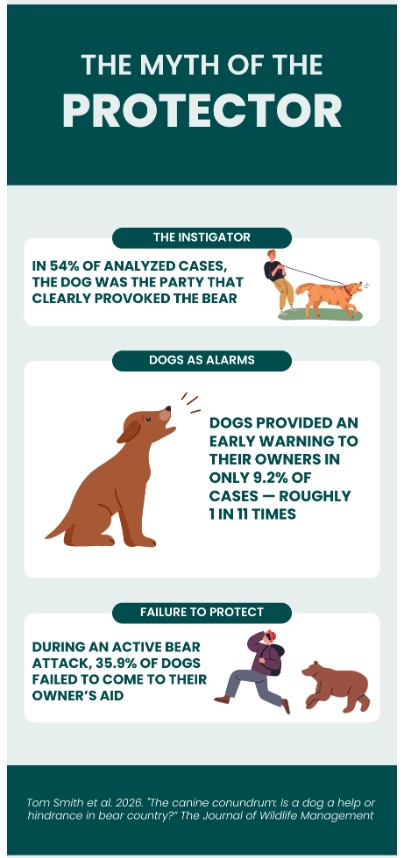
Contrary to some common wisdom, dogs also weren’t effective warning systems for bears. In fact, they alerted their owners early of a bear in only 1 in 11 of the encounters the study analyzed. Dogs provoked the bear, instigating the encounter, in more than half the cases. After the bear conflict began, things didn’t look much better: Dogs tangled with bears about 40% of the time, ran away in 20% of encounters, and didn’t engage at all in about 17% of cases. So much for dogs being excellent protectors.

Other findings were less surprising. Leashes were a major decider in the severity of the interaction. Unleashed dogs were involved in six times as many incidents as leashed pets. Smith said dogs without a leash can dart ahead of owners or crash through brush and spook a bear. Canines can also act as bear boomerangs. In 27 of the encounters, dogs brought a bear back to their owners. In 70% of these instances, the dog owner was injured. Worse yet, many owners in the data came to rescue their pet when it got in a scuffle with a bear, often with no deterrent. The result: 85% of the time, those owners were injured.

Additionally, the data reinforced something bear experts have known for years: the larger the group of people, the less likely the encounter. However, the presence of a dog dramatically shifts that risk. Dogs roughly doubled the odds of a conflict compared to the same-sized groups with no canine companions.

Taken as a whole, the data paint a portrait in which bears and domestic dogs don’t get along. Smith suspects it’s part of the long evolutionary relationship between bears and wolves. For thousands of years, wolves competed with bears for food, killed cubs and even kicked bruins off carcasses. Some of this behavior is on public display in places like Yellowstone National Park, where populations of both species flourish. Modern dogs may still trigger those ancient instincts.

Smith recognizes limitations and nuance in his data, too. For one, it’s important to note that the dogs in the analysis were domestic companions, not highly-trained guardian dogs meant to fend off predators — which data show can reduce bear presence at ranches and farms. Also, data on human-bear conflict inherently shows a bias, depicting only the encounters that went majorly wrong rather than the majority of experiences when people venture into the places bruins live and the species coexist without incident. “For the most part, people and their dogs pass through bear country without incident,” Smith wrote in the paper.

Should your pup join the hike?

“The takeaway isn’t to keep dogs out of bear country,” Smith said. “The takeaway is there are things you can do that greatly improve your odds.”

Best practices, backed by Smith’s data, say to travel in groups, eliminate smells if you’re camping and make noise. Bear bells, he says, don’t work. Above almost all else? “You have no business being in bear country without a deterrent,” Smith said.  “You have no business being in bear country without a deterrent.”  Dogs just don’t cut it on that front. According to Smith, bear spray has the highest likelihood of fending off an aggressive bear for the vast majority of recreationists in bear country. But firearms can work too for experienced users. Carry your spray (or gun) where you can reach it in a split second. No matter what deterrent you choose, practice with it. Bear encounters can happen in seconds.  If you do take your dog, consider a leash. “It’s not just dogs and bears,” Smith said. “It’s also dogs and everything else.” Smith’s own dog had been sprayed by a skunk twice in the last month. Mine finds few greater joys in life than chasing ground squirrels, marmots and grouse. So, we’re both faced with navigating how to behave in wild places with these family members that, if they see a deer or elk or bear, may not be able to hold themselves back.

Since talking with Smith, I’ve thought about the role Camas plays in bear country in a more nuanced way. She’s warned me about bears — even since that encounter on my jog. But she’s also ignored bears less than 30 yards away, chased wildlife she shouldn’t and, even in her younger days, treed a black bear.

The lesson isn’t that dogs don’t belong in bear country writ large. It’s that they’re dogs. If recreating in bear country is an odds game, they’re not doing you any favors. As much as we love and trust them, they’re unpredictable. And they can make things worse as often as they make things better.

“It’s a personal thing, it really is,” Smith said. “We work in statistics with a pool of instances. But you are not a pool of instances. You’re you.”
WATCH VIDEO

(SHOSHONE, Idaho, Aug. 6, 2026) — Stage 1 Fire Restrictions, which have been in place on National Forest Systems lands in the Cassia Fire Restrictions Zone since July 1, will extend to include all National Forest System, Bureau of Land Management, Bureau of Reclamation, and State lands, as well as private forest and rangelands, in the South Idaho Interagency Dispatch Area 12:01 a.m. Friday.

The purpose of the restrictions is to reduce the potential for human-caused ignitions.

Restrictions will apply to the following South Idaho Fire Restrictions zones, as defined in the 2026 Idaho Fires Restrictions Plan:

  • Sawtooth North Fire Restrictions Zone – All Sawtooth National Forest, BLM Twin Falls District, and Idaho State Lands north of Highway 20 to the northern most Sawtooth National Forest boundary. From Hill City east to the Craters of the Moon National Park Visitors Center.
  • Three Creek Fire Restrictions Zone – All BLM Twin Falls District and Idaho State lands south of I-84 south to the Idaho/Nevada border, west of Highway 93 to the Bruneau Canyon.
  • Shoshone Fire Restrictions Zone – All BLM Twin Falls District and Idaho State lands north of I-84 to Highway 20, from King Hill east to Massacre Rocks State Park.
  • Cassia Fire Restrictions Zone – All BLM Twin Falls District, Idaho State lands and Sawtooth National Forest lands from I-84/I-86 south of Idaho/Utah/Nevada border, east of Highway 93 to the Cassia County/Onieda County line.

Maps detailing where Stage 1 Fire Restrictions will be implemented will be posted online at https://www.fs.usda.gov/r04/sawtooth/alerts, https://www.blm.gov/programs/fire/regional-info/idaho/fire-restrictions, and https://www.idl.idaho.gov/fire-management/fire-restrictions-finder/.

Under Stage 1 Fire Restrictions, the following acts are prohibited:

  • Building or maintaining a wood-, charcoal-, or briquette-fueled fire outside of a permanent metal or concrete fire pit or grate that the Forest Service or BLM has installed and maintained at its developed recreation sites.
  • Smoking, except within an enclosed vehicle or building, at a developed recreation site, or while stopped in an area at least three feet in diameter that is barren or cleared of all flammable material.

Visitors outside of these designated sites may use a stove or grill equipped with a shut-off valve that is solely fueled by liquid petroleum or liquid petroleum gas fuels. Stoves or grills of this type can only be used in areas that are barren or cleared of all overhead and surrounding flammable materials within three feet of the device.

Additional restrictions may be necessary in the future. If conditions moderate, agencies will consider lifting restrictions earlier.

Violations of these restrictions could result in mandatory appearance in a federal court, fines, or jail time.

For additional information on fire restrictions, visit the fire restrictions website at https://www.idl.idaho.gov/restrictions.

A recently discovered virus with no vaccine, medication, or commercially available test has been confirmed in New York for the first time. The discovery suggests the spread of the Bourbon virus along with its primary carrier, the Lone Star tick. First discovered in 2014 in Kansas, the Bourbon virus causes fever, fatigue, rash, headache, body aches, nausea, and vomiting. In extreme cases, it can even be fatal. While diagnoses of Bourbon virus are rare — only five cases as of 2024 — the lack of testing and non-specific symptoms lead authorities to believe it could be much more widespread.

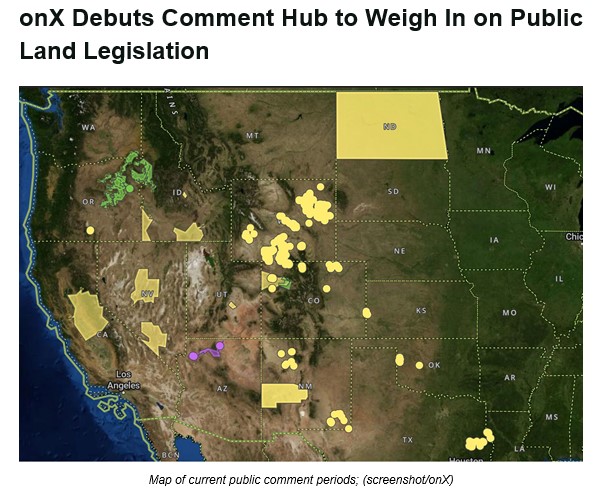
In an effort to bring more voices to bear on public lands issues, onX unveiled the Public Land Comment Hub today. This interactive map shows current proposals, color-coded by land management agency — U.S. Forest Service (green), National Park Service (pink), U.S. Fish and Wildlife Service (blue), and Bureau of Land Management (yellow). Users can click any shaded area to learn more about the issue, see how many days remain in the comment period, and immediately connect to the agency website to add their comment. The page also has resources on how to craft a good comment and a helpful acronym glossary to decode some of the bureaucracy.


HCN_Aug2026_LowRes PDF